Book An Appointment Book Online Video Counselling

A Non-Immigrant Visa Guide: Different Types and Their Purpose!

Loading

We all know that there are perks of going to an abroad destination on an immigration basis. You settle down in a foreign land and build your career and family from the ground up wishing for the heights of success. But not everyone is willing to leave the roots of their country, but something temporary to visit for, work for, or study for. There are high chances that the candidate would want to visit a foreign country just to relax, take the family out for a holiday, go on a corporate project, or just visit for research. That’s exactly known as a Non-Immigrant Visa.

If we talk about the textbook definition of the same- Common visas are non-immigrant visas, which are utilized for various purposes, including business trips, medical visits, and even to pursue further education abroad. An Indian national traveling abroad is required to possess either an immigrant visa or a non-immigrant visa.

In contrast to an immigrant visa, which grants permanent residence, an Indian national is obliged to demonstrate to the consular officer that they possess substantial connections to their country of residence and substantiate their intention to repatriate once their visit’s objectives have been fulfilled.

There are different Non-Immigrant Visa types and the process of every type varies from country to country. Every country has a different norm for a temporary visa permit and the rules are to be followed strictly. In this blog, we are exactly going to discuss various visa types and visa policies.

Your complete Non-Immigrant Visa Guide

Visitor Visa

A visitor visa for any nation is a type of non-immigrant visa that allows you to remain in a certain country for a set length of time. As a temporary visitor in a nation, you can often attend short-term business activities, visit relatives and friends, or travel as a tourist. A visiting visa also permits you to travel abroad for medical treatment. The goal of this visit, however, must be made quite plain and to the point.

The individual must also demonstrate a clear desire to return to the country of origin after the objective of the visit has been fulfilled. The visiting visa has a fixed deadline, and the applicant may be required to state the precise length of time they will stay in the nation.

What are the reasons that are classified for a Visitor Visa?

  • Visiting for holiday, vacation, or recreational purpose
  • Visiting friends or relatives abroad
  • Visiting for a business conference, workshop, or seminar
  • Visiting for medical treatment
  • Visiting for the graduation ceremony
  • Visiting for short-term work training or simulation.

Work or study (save for a brief recreational course of study as a pastime, etc.) is not permitted when in a nation on a temporary visiting visa. If you come as a tourist/visitor, you must seek to modify your status or move to a different visa category before working or studying in a foreign nation. There are various countries that allow visitor visas. Some of the popular countries are:

  • Australia
  • Canada
  • United States of America
  • United Kingdom
  • New Zealand
  • Schengen (European Countries)

The process and documentation of all countries might differ as per the respective country’s norms and regulations. Generally, the following things are required while filing for a visitor visa process. 

The essential conditions for a visitor visa are as follows:

– Health check-up.
– Financial papers
– Certificates of Character and Insurance
– Proof of Accommodation Other documents contain:
– Completed and filled out visa application form.
– Upload images digitally according to the parameters.
– Your passport must be valid for at least six months from the date of your anticipated departure from India.
– A photocopy of a valid passport’s bio page
– A copy of your two-way tickets, which you must send at the time of your application
– Recent bank statements as evidence of sufficient finances.
– An invitation letter from a sponsor, family member, or friend who lives abroad.
– Financial Statement of a Sponsor, Family Member, or Friend
– Passport photocopy of the sponsor.
– Marriage certificate, if you’re married to a foreign national.
– Minors must have their parents’ marriage and birth certificates.
– Proof of sufficient finances.
– Hotel reservation confirmation.

Once you have submitted the documents and completed the formal round of interviews as per the respective country regulations, you will have to wait for a certain time period again as per the country’s processing time for approval. The cost also varies from country to country.

For in-depth information on Visitor Visa:

Business Visa

A business visa is the best way to travel to a country temporarily for work purposes. Consultations, conducting essential business meetings, contractual discussions, visiting conferences, exhibitions, conventions, and so on are all possible work reasons. These visas necessitate extreme caution during the documentation procedure, and a slew of forms must be filled out precisely to avoid errors.

To grow a firm, it is critical to expand its horizons to new and faraway shores. Travelling overseas permits you to expand your firm to more profitable economic areas throughout the world. To travel for this purpose, one must hold a Business Visa. A Business Visa will greatly assist you in obtaining funding for your startup or meeting a potential client.

Reasons viable for Business Visa:

  • Attending a conference, meeting, or training Participating in a sports activity
  • Seeking funds to start, join, or operate an abroad firm.
  • Other commercial operations.
  • Employees of a corporation based in another nation can engage in the following corporate or intra-corporate activities:
    • As an internal auditor, you may advise, consult, troubleshoot, or train UK employees on a specific project within the same corporate group.
    • Additionally, you may conduct regulatory or financial audits for a foreign branch of the same group of companies as your employer.
    • A multinational firm or organization can provide the visitor with training in work practices and processes that are essential for their employment overseas but are not available in their home country.

Some of the popular countries which grant a business visa are as follows:

  • United Kingdom
  • United States of America
  • Canada
  • New Zealand
  • Australia

The process and documentation of all countries might differ as per the respective country’s norms and regulations. Generally, the following things are required while filing for a business visa process.

Required Documents for a Business Visa
– Personal information
– Compensation and monetary information
– Itinerary and record of past travels
– Evidence demonstrating your ability to sufficiently finance your accommodation
– Evidence of your ability to cover the cost of your air transportation to and from the United Kingdom.
– Evidence of your departure from the UK upon the conclusion of your visit Evidence of the business activities you intend to engage in while in the UK

There is an Eligibility Criterion for Acceptance of a Business Visa
– The minimum age requirement is 18 years.
– It is imperative that you possess the means to sustain yourself financially throughout the entire time of your visit.
– You are required to fulfil the fundamental health criteria set by the government.
– In order to engage in commercial activities, it is imperative that you possess a valid invitation from a reputable company based in the nation where you intend to conduct business.

Here, again the process and acceptance of the business visa totally depend on the regulations and rules set by a respective country. The interview and clarity of the purpose should be very much clear and to the point for getting an acceptance of the business visa. The cost of this type of visa differs as per the country.

For in-depth information on Business Visa:

Work Permit Visa

Work permit visas are provided either temporarily or permanently. A temporary work visa is valid for a set amount of time, after which the visa holder must renew if his employer wishes to extend his (employee’s) stay. The duration of a work visa is determined by the number of jobs you have and the labour market conditions. Every country in the world seeks to recruit bright people to live and work there. Australia, Canada, the United Kingdom, and the United States, like other countries, have their own distinct policies for work visas.

These rules assist them in encouraging specific businesses like information technology, core engineering, health care, and research, which they believe require a boost from smart immigrants. These visas are usually temporary and must be renewed on a regular basis, or until your employment contract expires. The re-application process for these visas can be challenging because the individual may be too busy at work to deal with it.

Reasons that are viable for a work visa:

  • An offer letter from an overseas organization
  • Promotion or transfer of position on a foreign land
  • Job changes to an overseas organization
  • Selection to a position after an internship done in a company abroad.

Some of the popular countries which grant a work permit are as follows:

  • United Kingdom
  • United States of America
  • Canada
  • New Zealand
  • Australia

The process and documentation of all countries might differ as per the respective country’s norms and regulations. Generally, the following things are required while filing for a work permit visa process.

Required documents for Work Permit Visa

–  All academic certificates must be provided in duplicate.
– Duplicates of professional certifications.
– Employment credentials from former employers.
– Letter of reference from an employer.
– Executed client agreement (if applicable).
– In addition to the listed documents, you may be required to provide additional information/documents as per the specific requirements of the immigration office of a given nation.

Eligibility Criteria for Obtaining a Work Permit Visa

–  You must provide evidence of your intention to depart the country upon completion of your employment and expiration of your authorized stay.
– It is important to possess sufficient funds to provide for both yourself and your dependents.
Lacking any criminal history.
– You do not have any medical conditions and possess certificates indicating good health.
– You would exclusively engage in the work assigned by your employer, without undertaking any additional tasks.

The process and acceptance of a work permit visa are contingent upon the regulations and rules established by the individual country. To obtain approval for a work visa, the interview and the objective of the trip must be clearly and concisely communicated. The cost of this particular visa varies depending on the country.

For in-depth information on Work Permit Visa:

Dependent Visa

A person who is a resident of a country or has a legitimate non-immigrant status may apply for a dependent visa for their immediate family members. The criteria for granting dependent visas to family members vary in each nation, therefore it is critical to work with a competent adviser to guide you through the procedure. Direct relatives who are eligible for a Dependent Visa include children, adopted children, parents, and spouses.

This visa requires a specific set of documents, as well as filled-out application forms. To avoid mistakes, the information must be filled out carefully. The conditions for this visa vary by nation and include a variety of requirements. These laws and standards are also subject to change in response to global situations, local requirements, the employment market, and other factors.

Some of the popular countries which grant a dependent visa are as follows:

  • United Kingdom
  • United States of America
  • Canada
  • New Zealand
  • Australia

The process and documentation of all countries might differ as per the respective country’s norms and regulations. Generally, the following things are required while filing for a dependent visa process.

Documents Required for Dependent Visa

– Required documents include a valid passport, marriage certificate, or
– Any additional paperwork for establishing the partnership
– Required documents include dependent children’s birth certificates, proof of sponsor finances (bank statements), and medical test results.

 – Sponsor’s proof of employment – Documents equal to certificate of eligibility.

Eligibility for Dependent Visa

– Applicants must have a valid passport.
– The sponsor must have sufficient funds to sustain their dependents
– Requirements for sponsorship include confirmation of work and income, a medical checkup, and appropriate insurance for dependents.
– Completed application with included fee

The application and acceptance of a dependent visa are subject to the regulations and guidelines imposed by the specific country. To be approved for a dependent visa, the interview and the purpose of the trip must be presented clearly and simply. The cost of this particular visa varies by nation.

For in-depth information on Dependent Visa:

Other types of Non-Immigrant Visa’s

While there is a brief explanation of popular non-immigrant visas above, other visa types and visa policies to look at and discuss on to. Following are some options for non-immigrant visas

  • Investor Entrepreneur Visa
  • Transit Visa
  • Religious Worker Visa
  • Domestic Employee Visa

While there are different implications, reasons, eligibility criteria, processes, and costs for every type of non-immigrant visa, every type of the same holds a different level of importance in every country and our lives as well.

That’s Where We Come In!

We at Rao Consultants are engaged to make your overseas dream come true. Right from fulfilling every student’s dream come true every single day for studying abroad, we also hold success and expertise in non-immigrant visas. With 20+ years of experience in the industry of immigration and overseas education, we strive to help your visions get fulfilled without any hassle.

Book your free consultation now!

Why Do So Many People Want to Move to Canada?

Loading

In Today’s entire wave of cutthroat competition and a knack for financial status, everyone is looking to settle down at a place where they can be satisfied financially, emotionally, and physically. In this scenario, Canada has become a popular destination for people to immigrate to Canada from India. Canada is known for its breathtaking landscapes, diversified culture, and high quality of life, making it the best nation to migrate to. But the real question that comes to our mind is what is it about this North American country that makes it so appealing and interesting for people to chase for a Canadian PR?

If you reading this blog, and are looking for the actual reasons why people settle in Canada from India, then we are about to give you all of them in this blog. So, Let’s dig in!

Immigrate to Canada from India- The Reasons!

Canada boasts a long-standing tradition of immigration that spans decades. A diverse culturalism is the basis of Canadian national identity and this is closely linked to immigration. It is not only true in the past but also applies to the future. According to forecasts, over the next few years, Canada will receive more than 100,000 immigrants from India every year. By 2025, it is expected that Canada will be receiving almost 500,000 migrants which could be the highest number of people applying for Canadian Citizenship Visa in one year ever.

  • Employment Opportunities

Canada has always faced employment and labor issues, which only increased during the COVID-19 pandemic. The unemployment faced by the country is very low. On the contrary, employment opportunities have reached their peak, with Canada recently publishing nearly a million vacant positions. Additionally, data suggests that companies are jumping to fill job openings and are re porting increasing labour shortages. The country is known for its stable job market, competitive wages, and work-life balance, making it the best option for people to Migrate to Canada who are seeking for career advancement.

  • High-Quality Education

Canada has been voted the world’s most educated country around the globe. With around 56% of the population having pursued some type of postsecondary education, the country has become a beacon for education. Canada has provided various free public schools and colleges and a compulsory schooling legislation to ensure that all citizens with a Canadian citizen visa have access to basic education. Additionally, Canada presses more on advanced education opportunities than other countries, making it a hot destination for students who want to study abroad. The students who have gone to study in Canada may also be able to apply for a Canada PR Visa.

  • Best Healthcare Facilities

One of the best reasons that makes people move to Canada, is Canada’s best healthcare system. The national health insurance system in Canada ensures that nobody- even a non-resident of the country will be denied medical facilities due to its cost. Unlike other nations, Canada provides a comparatively affordable healthcare service that won’t be heavy on your pockets. Each province and territory has a particular health plan that includes a variety of products and services. People who move to Canada can enroll in their respective province’s health insurance plans and receive a health card. The majority of the citizens are not required to pay for most medical and emergency treatments under the Canadian Public Healthcare System.

  • Diverse Culture and Population

Canada is well known for its multiculturalism, commitment to diversity, a sense of belonging. The country takes pride in being a melting pot of various cultures, languages, and customs, as it welcomes different immigrants and refugees. This results in a lively and inclusive society in which people of all origins may thrive. Canada enacted the Canadian Multiculturalism Act in 1988. It was one of the world’s first laws to formalize the federal government’s commitment to catering to a diverse society. A previous research done by Statistics Canada discovered that the majority of immigrants experience a sense of belonging in the country.

  • Security and Safety

Canada has a substantially steeper crime rate than most of the other countries throughout the world. It also has far lower rates of gun violence than the United States of America. Canada typically performs the best in international polls of safety, progress, and quality of life. The Global Peace Index consistently ranks Canada as one of the top ten safest countries in the world. According to recent statistics, Canada ranks second on the list of the safest countries for LGBTQ immigrants.

  • Stable and Secure Political System

Canada’s political scenario is quite stable, and democracy is highly valued by the citizens who hold a Canada PR. In the year 2022, Canada was rated fifth on the Economist Intelligence Unit’s global democracy ranking, ahead of other countries. Canada’s leaders are democratically chosen, and there is minimal political instability in the country. If Canadians are unsatisfied with their government, they can peacefully demonstrate and push for change, or they can vote for a new party in the next election.

  • Prosperous Economy

Canada is regarded as one of the most economically stable nations in the world. While many nations have faced long-term economic consequences from the COVID-19 pandemic, Canada has recovered strongly from the same. By the conclusion of the last quarter of 2022, Canada’s economy has grown at a 6.7% rate, surpassing its pre-pandemic level. As there are a lot of employment opportunities provided in the country, the economy is welcoming a vast array of immigrants across the globe. With higher-than-ever immigration goals and objectives and a thriving economy, potential immigrants who want to move to Canada are well-positioned to succeed in Canada.

So, Are you ready to Settle in Canada from India?

To summarize, Canada’s allure as an immigration destination is diverse, including aspects such as quality of life, cultural diversity, economic prosperity, and scenic beauty. With its inclusive culture, and other opportunities Canada continues to draw people from all over the world to opt for a Canadian Citizen Visa for a better and bright future. Whether it’s the prospect of a fresh start, job progress, or the opportunity to experience and explore, Canada’s attraction as a hospitable country is apparent.

Are you looking to Immigrate to Canada from India?

We are sure that this question is asked by various people out there. But at Rao Consultants, we ask this question a thousand times to motivate everyone who is looking to settle in Canada from India. Our expertise is proven to be the results we have provided over the last 2 decades – by successfully getting Canadian PR visas for several people in India. We take pride in being one of the fewest consultants in Gujarat who are IRCC and CICC authorized. With a lot of options to enter Canada for Immigration, our team of experts caters to all your needs and questions with ease. So, if you are looking to Move to Canada, team Rao is all here for you.

Connect with us for a free consultation now!

Unlocking the Potential: Immigrant Children’s Educational and Work Success in Canada

Loading

It is not a piece of old news that, Canada has been home to various immigrants and is inviting more every passing year. Canada is known for its welcoming environment for people who are looking for a better standard of living, educational & health facilities, and many other benefits. Recently a study has found out that. According to a study that was conducted not too long ago by Statistics Canada. Newcomer Immigrant children in Canada have superior academic and professional outcomes. Simply said, newcomers who arrived in the country while they were youngsters have a greater likelihood of pursuing higher education and having better economic outcomes than those who arrived later than that. As a matter of fact, by the age of 25, this particular group of newcomers reported significantly greater wages than any other group of Canadian taxpayers.

Educational Options for Immigrant Children

  • Canada provides free public education to all people, including immigrant children, ensuring equitable educational opportunities.
  • Immigrant children benefit from multicultural programs and support services in schools, which assist them to assimilate into the Canadian educational system.
  • Children who speak languages other than English or French can benefit from bilingual education, which makes the transition easier.

Support Networks and Mentorship

  • Community organizations, immigrant settlement agencies, and mentorship programs help immigrant families and children navigate the educational system.
  • Peer support groups and cultural associations allow immigrant children to connect with people who have had similar experiences and problems.

Looking at data from the Longitudinal Immigrant Database, an important data model that tracks long-term data on immigrants who come to Canada, researchers discovered a link between how quickly a newcomer was admitted to Canada and their likelihood of pursuing post-secondary education.

For example, around 77.3% of immigrants who arrived in Canada at the age of four completed postsecondary education by the age of twenty. The findings were consistent with those who Settled in Canada between the ages of 5 and 9, with 69.9% participating in postsecondary education, and those who settled in Canada between the ages of 10 and 14, with 61.3% participating.

In comparison, only 59.9% of all Canadian tax filers completed post-secondary education by the age of 20. This means that newcomer cohorts participated in postsecondary education at a considerably higher rate than all Canadians.

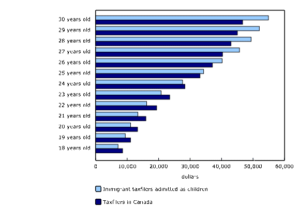
The findings were consistent with the economic outcomes of newcomers based on how young they were accepted to Canada. Newcomer tax filers who were accepted to Canada reported greater salaries than the average of all Canadian tax filers their age.

However, this result was delayed due to the average age of tax filers. For example, immigrants admitted to Canada as children earned lower median wages than all other Canadian taxpayers between the ages of 18 and 24.

However, beyond the age of 25, the median earnings of this newcomer cohort equalled or exceeded the median pay of all Canadian tax filers in a comparable age category.

By the age of 30, newcomers admitted to Canada as youngsters earned a median pay 17.6% higher than all other Canadian tax filers of the same age. The results are as follows:

What Exactly is The Outcome?

Immigrant Canadian children had superior academic and employment prospects. The findings of this study appear to imply that newcomers who arrive in Canada at a young age have a beneficial impact on both higher education participation and labour market results, with a greater benefit for those who arrive earlier. The study also implies that newcomers accepted to Canada sooner have better outcomes than not only those who enter later but also the Canadian population as a whole. The study does not provide causes for this phenomenon, and more research is needed to explain how these results came about.

This data adds to existing work that demonstrates a positive relationship between immigrants’ youth at the time of admission to Canada and successful economic outcomes in the country—in the short, medium, and long run.

Furthermore, additional research has found that the beneficial association between how quickly an immigrant arrives in Canada and their earnings grows over time. This is also reflected in the CRS’s age-weighted scoring system, with younger arrivals benefiting from their youth.

To Finally Conclude!

Canada has always been ahead in providing new opportunities to those who seek success and solace at the same time. The country is known for its vigour to provide the best possible facilities to newcomers and make sure that they get everything they wish for. That is exactly what we at Rao Consultants want for you. A dream that can be easily fulfilled by our expert guidance and 2 decades of experience.

Are you looking to settle in Canada?

Connect with Rao Consultants now!

How to Ace IELTS (Updated 2025)

Loading

The International English Language Testing System A.K.A IELTS is a boon for every student’s study abroad dream. Every university or college has a specific requirement of certain bands depending on the requirement of the course! If a student wants to get admission to that particular college/university and course- he/she has to make sure that the score is achieved. The four modules of the examination, i.e., Listening, Reading, Writing, and Speaking might sound and look easy- but they are not. You can make it easier with enroll in Best IELTS Coaching.

You need resilience, practice, and utmost concentration if you want to crack the IELTS exam. The sections if worked on properly will help you score your dream bands and eventually your dream university/college. While we understand that it’s easier said than done! – We have just the right tips to ace IELTS in 2024 for you!

Let’s Look at it Section Wise First!

Prepare for the IELTS Exam- Reading Section!

Generally, reading section becomes easier if you catch the essence of the passage given to you. You will be facing three passages with different difficulty levels which are to be finished in an hour’s time. Thus, the dedication of 20 minutes to one passage makes it a challenge. It is also noted that academic reading tests are not as easy as general reading tests. Let us look at the tips!

  • If you are not able to answer a question, instead of hooking on to it, move to the next and save that question for the last.
  • Make sure to carefully review the graphs, images, or any figures given in the passage as you work on solving the questions. Every small detail is important.
  • Make sure to carefully read the questions in the given passage and mark the lines that you feel can be the potential answers.
  • You can use capital letters for answering the questions.
  • Always make sure that you have checked the spelling and grammar before you submit your final answers. A small mistake can land you in a soup.

Prepare for the IELTS Exam- Writing Section!

When we generally end up asking about which is the hardest module students find, Writing tops it. Unlike, Listening and Reading, here you have a diagram or a question that needs to be answered considering your own creativity and language flair. Let’s look into some good writing tips!

  • Timely completing the task is very important here. Try giving more time to task 2 and less time to task 1.
  • While practicing, make sure to write a little more than 150 words in task one and 250 words in task two.
  • Always provide conclusions to your tasks.
  • You should avoid repetition of words and phrases while constructing a paragraph.
  • More usage of active voice should be done and less passive voice.
  • Try and write to the point instead of writing lengthy sentences.
  • Always proofread the answer written before you submit it.

Prepare for the IELTS Exam- Listening Section!

The listening section in an IELTS exam is considered the easiest section if practiced correctly. There are a lot of intricacies to consider before you even start listening to audio and answering the questions. Here are some tips for you to ace the same!

  • Take advantage of the provided time and familiarize yourself with the questions before the audio actually begins.
  • Always make sure to write the pointers on the question paper while listening to the audio.
  • As the recording will be played only once, focus and attentiveness while listening to the audio is a must.
  • Always make sure to answer the question within the asked word limit.
  • Lastly, grammar checks and proofreading the answers for spelling are very important.

Prepare for the IELTS Exam- Speaking Section!

Here is the deal with the speaking section. This section needs a lot of practice and resilience in all three sections as it purely depends on your creativity. As you have an allocated time for each particular task, you need to be well-ready and spontaneous for this section. Let’s look at some tips for the same!

  • While giving the interview, make sure that you have understood the question correctly.
  • Speak at a moderate pace to ensure the examiner can understand you clearly and properly.
  • Your speech should sound confident and assuring.
  • Make sure that you do not divert from the question asked.
  • If you did not understand the question, ask the examiner to repeat the same.
  • Pay attention to the words you choose while speaking, the way you have constructed the sentences, and the overall tone of speaking.
  • Make sure not to take long pauses while speaking.

We understand that these tips might seem a little overwhelming. But truth be told, with seamless guidance from an expert tutor, lots of practice, and mock tests you can easily Maximize your IELTS score. Meanwhile, we have talked about some section-wise tips, here are some overall tips to ace the IELTS exam.

Crack Your IELTS EXAM- General Tips!

By following the below-mentioned tips, we are sure that you will excel in your IELTS test remarkably.

  • Read- Read and Read! – Make it a habit to read, pick up new terms, and attempt to utilize them in the right contexts. Read every day or listen to English news in newspapers. Develop your capacity to look for details and take notes when reading to hone your talent. Since you have a limited amount of time to respond, you must manage the time restriction.
  • Increase your writing skills! – Work on writing more quickly by practicing timely writing. You will be able to handle task 2 better, which is lengthier and requires more time, by polishing your writing abilities. Make a point of the new terms and use them to construct sentences. Examine the task 2 question closely to ensure that all of its components have been covered. Work at your own pace so that you have time to go over what you have written.
  • Enhance your Listening Skills! – You can watch daily English news and write about it afterward. You only get one chance to hear the tape, so pay attention and practice your listening skills to ensure that you don’t miss anything. However, if you would like to listen to the tape again, repeat reading the script and take note of any helpful expressions. You want to be aware of the precise questions posed and make sure you have the guidelines.
  • Increase your Vocabulary! – As your reading comprehension improves, be sure to pick up new vocabulary and apply it appropriately. You must read a lot to accomplish this. Make a note of the new terms and practice using them in suitable sentences. Read editorials and articles from various periodicals to become familiar with new vocabulary. To incorporate new words into your everyday speech, you must use them frequently.
  • Fluency and Pronunciation are a must! –There are three sections to the speaking section: a free interview, a structured interview, and a brief discussion. For four to five minutes, candidates will be asked two to three quick questions on well-known subjects. Talk in English for a while throughout this practice, paying close attention to your pronunciation. To get knowledgeable about several subjects and be able to communicate about them, read and listen to a variety of topics. Note your speaking weaknesses and strengths by recording yourself.

These tips are a game-changer for you want to excel in the IELTS examination in 2024. But again, we understand that the pressure can be immense, and language jitters are for real! Any or every examination can get us nervous.

That’s exactly where we come in. At Rao Consultants, we have highly trained experts who are certified IELTS practitioners and have many tips that can help you ace your IELTS examination with an excellent score. Right from updated materials to a bucket full of mock tests, and sectional tests, we have got you all covered! Additionally, Rao Consultants has been constantly ranked as the best IELTS coaching in Ahmedabad!

You can check our awards and recognitions here: https://www.raoconsultants.com/awards-accreditations/

Finding it difficult to Crack the IELTS Examination?

Get in touch with us for IELTS coaching now!

Your Road Map for Studying Abroad: A Complete Student Visa Guide

Loading

It’s no shocking news that every student is looking for better opportunities, practical study methods, and a career that makes them succeed ahead and secure their future eventually. We at Rao Consultants have seen tremendous growth in students who have been studying abroad and are increasing in number on a daily basis. Students want to try different countries, elect courses relevant to their field, and make sure they get the best university/college that the respective country has to offer.

However, we understand that choosing a particular college, country, and course can be a lot of hassle and it takes a lot of research before you decide anything. As -consuming as it can be, it is also overwhelming and can leave you confused. So, here we are, making your search a little simple and not-at-all complicated Student Visa Guide.

In this blog, we are going to discuss the 6 most popular study destinations and other emerging countries, the top courses, and universities they have to offer, the process, costs, and career opportunities- a.k.a, the complete student visa guide.

Let’s talk about- CANADA!

Every year, Canada opens its doors to many international students from various corners of the globe. Study in Canada is a wise investment for your future. Explore the compelling reasons to choose Canada as your destination for overseas education! Canada is known for its excellent quality of life. International students are entitled to the same rights and freedoms as all Canadians. This includes the fundamental principles of human rights, equality, diversity, and a stable, peaceful society. From elementary to postsecondary studies, Canada is well-known for providing high-quality education and research possibilities. You will also be able to switch between types and degrees of education without encountering hurdles typical in other parts of the world. Canada is a welcoming, safe, and culturally diverse community.

Top Courses Offered by Canada!

  • Information Technology
  • Engineering
  • Health care, Hospitality and Tourism Management
  • Business and Management
  • Environmental Science and Sustainability

Estimated Living Cost: The living cost in Canada ranges from 15,000 to 20635 CAD per annum.

Estimated Tuition Cost: The tuition cost in Canada ranges from 10,500 CAD and goes up to 33,000 CAD depending on the course and college/university selected.  

The Top 10 Colleges/Universities Offered by Canada!

  1. Algoma University
  2. St. Clair College
  3. Cape Breton University
  4. Fanshawe College
  5. Humber College
  6. Lakehead University
  7. Loyalist College
  8. University Canada West
  9. Sheridan College
  10. Yorkville University

Job Prospects: Canada’s job market is witnessing a tremendous growth pattern. With many international students journeying to the country and practically developing their skills, there is a high demand for skilled labour in the country with very good pay.  

Let’s take a look at the UNITED STATES!

The United States is recently becoming a hub for international students seeking to learn and discover themselves. It invites students from across the world due to the excellent quality of education it provides. Study in USA is an amazing opportunity for students to immerse themselves in a unique culture that is diverse and welcoming. Being a hub for immigrants across the world, studying in the United States would expose you to new cultures, and new food, and allow you to create a global network. The educational programs provided in the United States can allow you to participate in interesting research under exceptional professors who have made significant contributions to the field of your choice. The master’s and bachelor’s programs in the United States can open several doors for you in the industry that you have chosen.

Best courses offered by the United States!

  • Computer Science
  • Data Science
  • Finance
  • Psychology and Counselling
  • Healthcare
  • Biotechnology and Biomedical Science

Estimated Living Cost: The living cost in the United States ranges from 10,000 to 25,000 dollars per annum.

Estimated Tuition Cost: The tuition cost in the United States starts from 10,000 dollars and goes up to 55,000 dollars depending on the course and college/university selected. 

Top Colleges/Universities Offered by the USA!

  1. American University
  2. Florida International University
  3. Belmont University
  4. Eureka College
  5. Cleveland State University
  6. Kent State University
  7. DePaul University
  8. Lake Land University
  9. Edgewood College
  10. Rutgers University
  11. California State University Long Beach
  12. Illinois Institute of Technology
  13. University of Illinois
  14. Jacksonville University

Job Prospects: As per our recent findings, the United States job market is at its peak and is the strongest. The economy has experienced job growth for 39 straight months, making it the fifth-longest streak of job increase in recorded history of the USA.

What Makes the UNITED KINGDOM special?

The United Kingdom is one of the top choices for students aiming to study overseas. Every child once dreamed of Study in UK and living the dream. The UK is renowned for its diversity, the amazing culture it offers, and its community as well. With a large number of immigrants travelling to the UK, there is a community present for each individual who seeks to study in the nation. What makes the UK a good choice, is their one-year master’s programs that are globally recognized. A year of education, and you receive an opportunity to explore and discover opportunities across the world. You will also be able to create and develop a global network within this rich country.

Let’s Take a Look at The Best Courses to Study in UK

  • Nursing
  • Law
  • Media And Communication
  • Art & Design
  • Hospitality & Tourism
  • Business & Management

Estimated Living Cost: The living cost in the United Kingdom ranges from 12,000 to 16,000 Euros per annum.

Estimated Tuition Cost: The tuition cost in the United Kingdom starts from 11,000 Euros and goes up to 38,000 Euros depending on the course and college/university selected. 

Top Colleges/Universities Offered by the UK!

  1. Cardiff University
  2. Middlesex University
  3. Durham University
  4. University of Aberdeen
  5. Heriot-Watt University
  6. University of Greenwich
  7. Kingston University
  8. University of Hertfordshire
  9. Leeds Beckett University
  10. University of Roehampton

Job Prospects: While 2023 showed a decline in the job market, the year 2024 is expected to rise in every manner for the country. Right from booming nursing jobs, to gradual increments in the IT sector, the UK has an array of jobs to offer to the international students.

Why NEW ZEALAND is a good option?

Ranking fourth on the Global Peace Index 2023 shows how safe and impressive New Zealand is. This shows how peaceful and safe the nation is. New Zealand offers a multicultural environment for its citizens and the students who aim to Study in New Zealand The country even offers an affordable education with high quality as well. Kiwi universities are immensely supportive as well. This includes academic support, visa and health services, and career counselling as well. This will assist you in focusing on your educational journey and developing yourself with time.

Top courses for you to Study in New Zealand!

  • Hospitality and Tourism
  • Poultry and agricultural
  • Fashion Design
  • Film Studies
  • Culinary Arts

Estimated Living Cost: The living cost in New Zealand ranges from 15,000 to 25,000 NZ dollars per annum.

Estimated Tuition Cost: The tuition cost in New Zealand starts from 9000 NZ dollars and goes up to 50,000 NZ dollars depending on the course and college/university selected.

Top Colleges/Universities Offered by New Zealand!

  1. Nelson Marlborough Institute of Technology
  2. University of Otago
  3. NorthTec
  4. Victoria University of Wellington
  5. Otago Polytechnic
  6. University of Canterbury
  7. Southern Institute of Technology
  8. University of Waikato
  9. Toi Ohomai Institute of Technology
  10. Lincoln University
  11. The University of Auckland
  12. Auckland University of Technology
  13. Massey University

Job Prospects: According to our recent findings, the job market in New Zealand has seen an increase of a good amount of percentage making it easier for fresh graduates to find good-paying jobs there. Right from fashion design to the culinary industry, job prospects in New Zealand are in requirement of fresh faces and talent highly these days.

Study in GERMANY

Recently, Germany has become a famous study destination for international students. The nation is renowned for its affordability and higher educational standards. The low tuition costs and the English teaching programs in Germany make it an excellent destination for you. If you’re seeking to Study in Germany where the cost of living, and tuition fees are all affordable factors, then Germany is the nation you seek. German universities are renowned for their excellent quality of teaching.

What are the best courses for you to study in Germany?

  • Psychology
  • International Business
  • Automotive Engineering
  • Information Technology
  • Biomedical Science
  • Mechanical
  • Computer science
  • Architecture

Estimated Living Cost: The living cost in Germany ranges from 12,000 to 15,000 Euros per annum.

Estimated Tuition Cost: The tuition cost in Germany begins from 10,000 Euros and can go up to 30,000 Euros depending on the course and college/university selected.

The Top Colleges/Universities Offered by Germany!

  • Berlin School of Business and Innovation
  • EU Business School
  • Gisma Business School
  • International School of Management
  • Munich Business School

Job Prospects: Germany is marking its way in the job market for the upcoming years. The need for highly skilled labours has arisen and employment opportunities have increased in every field the country has to offer. Right from the city of Berlin to Stuttgart, the job prospects are high and well-paid.

Why should you choose IRELAND?

Ireland boasts one of the strongest educational systems in the world, therefore there are numerous reasons to study here. Schools and universities are worldwide networked, and graduates from Irish education institutions can pursue a variety of vocations all around the world. Ireland is an island nation off the western coast of Europe. It is the continent’s second-largest island, following Great Britain. It is also noted for its stunning green countryside, intriguing history, and kind people. Ireland has seven top-tier universities and a strong emphasis on research and global collaboration, making its education system one of the greatest in the world. Studying in Ireland can give you a solid foundation for a successful career. The educational quality in Ireland is commendable, encompassing both knowledge transmission between institutions and global firms and instruction that meets the demands of a competitive economy.

What are the best courses for you to study in Ireland?

  • Data Science
  • Engineering
  • Computer Science
  • Business Analytics
  • Pharmaceutical Sciences

Estimated Living Cost: The living cost in Ireland ranges from 10,000 to 20,000 Euros per annum.

Estimated Tuition Cost: The tuition cost in Ireland starts from 9000 Euros and goes up to 37,000 Euros depending on the course and college/university selected.

The Top Colleges/Universities Offered by Ireland!

  • Dublin City University
  • Griffith College
  • Maynooth University
  • Technological University Dublin
  • University of Cork

Job Prospects: Ireland is expected to see a high rise in technological jobs in the upcoming years. They want highly educated and skilled employees as they are deemed the best in the sector. The salary is great and the corporate environment is safe as well as positively competitive.

The OTHER COUNTRIES you can explore for Studying Abroad.

While the student crowd majorly looks forward to choosing from the countries explained above, there are many other countries that have opened their doors to international students and have a great career prospect available for the same. There’s no doubt that these countries are famous for their living standards and for their presence in the economy.

Following are The Countries to Explore:

  1. France
  2. Australia
  3. Hungary
  4. Dubai
  5. Malta
  6. Italy
  7. Netherlands
  8. Russia
  9. Poland
  10. Singapore
  11. Spain
  12. Turkey
  13. Switzerland

The above list of countries is also the best to study in as it totally depends on the course which you are willing to study. Every country specializes in one or the other sector and we are sure that in today’s time, everyone wants to study abroad and explore options that are not monotonous and something out of the box that challenges them.

TO CONCLUDE!

We at Rao Consultants understand your need and goals to study abroad and how much of a hassle it can be while searching for the best course, college, and country. With this information presented above, we are sure we can help you choose something that is suitable for you and your career. Your resources and your education are very important and it is highly suggested that choosing to study abroad should be properly researched and talked into. We really hope this complete student visa guide helps you in fueling your research of studying abroad.

For personalized assistance, you can connect with us anytime!

Don’t Let a Low CRS Score Stop Your Canadian Immigration Dreams: A Guide to Navigating Express Entry

Loading

Thinking about making Canada your new home? The Express Entry system offers a fast track to permanent residency for skilled workers. But a key factor influencing your success: your Comprehensive Ranking System (CRS) score.

A higher CRS score means a better shot at receiving an Invitation to Apply (ITA) for permanent residency. Recently, general Express Entry draws demanded scores above 500, creating stiff competition. But fear not, even with a lower CRS score, there are ways to navigate the pool and increase your chances!

Understanding Express Entry:

Express Entry manages three immigration programs:

  • Federal Skilled Worker Program (FSWP)
  • Federal Skilled Trades Program (FSTP)
  • Canadian Experience Class (CEC)

If you’re interested, you’ll need to assess your eligibility and create an Express Entry profile to get your CRS score.

Working with Different CRS Score Scenarios:

Express Entry draws set minimum CRS scores for receiving an ITA. These scores vary depending on the draw type:

  • General draws: Typically have higher CRS requirements.
  • Category-based draws: Target specific needs (e.g., healthcare) and often have lower CRS cut-offs (ranging from 336 to 437 in 2024).

So, while general draws might seem out of reach now, category-based draws offer an opportunity! In fact, over 16,000 candidates with lower CRS scores received ITAs through these draws in 2023.

Boosting Your CRS Score:

Here are some ways to improve your CRS score while you wait for a draw:

  • Language Skills: Brush up on your English or French with IRCC-approved language tests.
  • Education: Consider pursuing additional studies. A post-secondary degree, especially one exceeding three years, can significantly boost your score.
  • Age: The earlier you apply, the better. Younger candidates receive more points for age.

Provincial Nominations: A Game Changer:

Securing a provincial nomination can dramatically increase your CRS score by a whopping 600 points, practically guaranteeing an ITA. Explore various Provincial Nominee Programs (PNPs) tailored to specific occupations or regional needs.

Understanding Provincial Nominee Programs (PNPs):

PNPs allow provinces to nominate candidates who can contribute to their local economies. Each province has unique streams targeting specific skills or professions. While a nomination doesn’t guarantee permanent residency, it significantly strengthens your profile in the eyes of IRCC.

The Takeaway: Strategic Planning is Key

A low CRS score shouldn’t be a deal breaker. With strategic planning and perseverance, you can still achieve your Canadian immigration goals! Here’s how:

  • Focus on language skills and education to improve your CRS score.
  • Explore provincial nomination opportunities that align with your skills and experience.

By taking these steps, you can enhance your profile, increase your CRS score, and get one step closer to making Canada your new home. So don’t wait, start planning your journey today!

Conclusion:

Rao Consultants is a leading immigration consultancy firm with over 20 years of experience helping individuals navigate the complexities of Express Entry and Canadian immigration. We offer comprehensive support throughout the entire process, including CRS score optimization, language test preparation, and provincial nomination guidance. Contact Rao Consultants today for a free assessment and let us help you turn your Canadian immigration dreams into reality.

U.S. Visa Processing in India: A Record Year of Efficiency and Innovation

Loading

Transformative Advances in Streamlining Procedures and Enhancing Applicant Experience

2023 marked a watershed moment for US visa for visitors processing in India. The U.S. Consular Team shattered previous records, issuing a staggering 1.4 million visas, a 60% increase compared to 2022. This surge was met head-on with increased staffing, innovative solutions, and streamlined processes, resulting in a 75% reduction in US visa for indians appointment wait times.

Unprecedented Demand: A Rising Tide of Applications

The year 2023 witnessed a remarkable upsurge in visa applications from India. This can be attributed to several factors, including:

  • Pent-up demand: Travel restrictions due to the pandemic had created a backlog of applications.
  • Economic growth: India’s burgeoning economy is driving increased travel for business, education, and tourism.
  • Stronger educational ties: The U.S. remains a top destination for Indian students, with over 140,000 student visas issued in 2023, the highest globally for the third consecutive year.

This surge presented a significant challenge for US Embassy in India consular services. However, they rose to the occasion with a multi-pronged approach.

Staffing Up for Success: Meeting the Challenge Head-On

Recognizing the need for increased capacity, the U.S. Embassy and Consulates implemented several staffing initiatives:

  • Temporary staffing surge: A three-month surge in Mumbai, India’s commercial capital, expedited processing during peak season.
  • Increased permanent staff: Investments were made to add permanent staff across various consulates, ensuring long-term efficiency.
  • Strategic resource allocation: Personnel were strategically deployed to areas experiencing the highest demand.

These measures significantly improved processing capacity and reduced wait times. US visa processing, once taking up to 1000 days, now average a mere 250 days, a remarkable improvement.

Innovation Drives Efficiency: Streamlining the Process

Beyond staffing, the U.S. Consular Team embraced innovative solutions to streamline processes:

  • Enhanced online application system: An improved online platform facilitated easier application submission, document upload, and communication.
  • Virtual interviews: For certain visa categories, virtual interviews offered a convenient and efficient alternative to in-person appointments.
  • Data-driven decision-making: Utilizing data analytics, officials could identify areas for improvement and optimize resource allocation.

These innovations not only reduced wait times but also improved the overall applicant experience.

Looking Ahead: Building on Success

The success of 2023 paves the way for a brighter future for US visa processing in India. Looking forward, we can expect:

  • Continued focus on efficiency: The U.S. Embassy and Consulates are committed to further streamlining processes and reducing wait times.
  • Pilot programs: Initiatives like the upcoming pilot program allowing eligible H1B holders to renew visas within the U.S. demonstrate a commitment to innovation.
  • Stronger U.S.-India ties: Efficient US Visitor Visa Processing fosters stronger educational, business, and cultural ties between the two nations.

Impact on Specific Sectors:

Education: Efficient US Student Visa Process has significantly benefited the Indian education sector, attracting more students to U.S. universities.

  • Increased student mobility: Faster US visa processing encourages more Indian students to apply and attend U.S. universities, contributing to the $6 billion generated by international students annually (Source: NAFSA: Association of International Educators).
  • Enhanced academic diversity: A wider pool of talented Indian students enriches university campuses, fostering cross-cultural exchange and innovation.
  • Stronger alumni network: Returning graduates contribute to the Indian economy and serve as bridges between the two nations.

Business: Streamlined US visa for indians procedures have boosted U.S.-India business ties:

  • Facilitated trade and investment: Easier travel for businesspeople enables increased trade and investment, benefiting both economies.
  • Enhanced entrepreneurship: Faster US Visa Processing encourages Indian entrepreneurs to visit the U.S. to explore opportunities and collaborate with American counterparts.
  • Knowledge sharing and innovation: Increased business interaction fosters knowledge sharing and joint ventures, driving innovation in various sectors.
  • Tourism: Improved US visa for visitors processing has fueled a tourism boom:
  • Increased tourist arrivals: Reduced wait times have led to a surge in Indian tourists visiting the U.S., boosting the American tourism industry.
  • Economic benefits: Tourism spending by Indian visitors contributes significantly to the U.S. economy, creating jobs and supporting local businesses.
  • Cultural exchange: Increased tourism promotes cultural understanding and appreciation between the two nations.

Challenges and Opportunities:

Despite the progress, challenges remain:

  • Visa wait times for certain categories: While US visa processing wait times have reduced, processing times for other categories like work visas still require improvement.
  • Limited appointment slots: The increased demand can still outpace available appointment slots, leading to frustration for applicants.
  • Complex application process: The application process can be perceived as complex, requiring further simplification and user-friendly guidance.

Opportunities for further improvement include:

  • Expanding virtual interviews: Expanding the use of virtual interviews for more visa categories can improve efficiency and convenience.
  • Data-driven resource allocation: Continued use of data analytics can optimize resource allocation and further reduce wait times.
  • Enhanced communication: Clearer and more timely communication regarding application status and wait times can improve the applicant experience.

Comparative Analysis:

Comparing the US visa processing system in India to other countries reveals both strengths and areas for improvement:

Strengths:

  • Transparency: The U.S. system provides detailed information on visa requirements and processing times on its website.
  • Online application: The online application system facilitates easier submission and document upload.
  • Data-driven approach: Utilizing data analytics for decision-making is a best practice adopted by countries like Australia and Canada.

U.S. Visa Processing in India

Conclusion: A New Chapter in U.S.-India Relations

The record-breaking year of 2023 marks a significant milestone in US visa for visitors relations. By embracing increased staffing, innovative solutions, and data-driven decision-making, the U.S. Consular Team in India has successfully navigated the surge in applications. This not only benefits individual applicants but also strengthens the overall relationship between the two nations. As we move forward, we can expect continued progress and collaboration, paving the way for a future of increased understanding and collaboration between the United States and India.

Frequently Asked Questions

1. Q: What contributed to the surge in U.S. visa applications from India in 2023?

Several factors contributed, including pent-up demand due to pandemic-related travel restrictions, India’s economic growth driving increased travel, and the U.S. remaining a top destination for Indian students.

2. Q: How did the U.S. Consular Team address the increased demand for visa processing in India?

The U.S. Embassy and Consulates implemented initiatives such as a temporary staffing surge, increased permanent staff, and strategic resource allocation to improve processing capacity and reduce wait times.

3. Q: What innovations were introduced to streamline the U.S. visa processing in India?

Innovations included an enhanced online application system, virtual interviews for certain visa categories, and data-driven decision-making to identify areas for improvement and optimize resource allocation.

4. Q: What was the impact of improved U.S. visa processing on the Indian education sector?

Faster visa processing encouraged more Indian students to apply and attend U.S. universities, contributing to increased student mobility, enhanced academic diversity, and a stronger alumni network.

5. Q: How did streamlined U.S. visa procedures benefit U.S.-India business ties?

Streamlined procedures facilitated trade and investment, enhanced entrepreneurship, and encouraged knowledge sharing and innovation, fostering stronger U.S.-India business ties.

6. Q: What are the challenges that still exist in the U.S. visa processing system in India?

Challenges include wait times for certain visa categories, limited appointment slots, and the perceived complexity of the application process, particularly for work visas.

7. Q: How can virtual interviews be expanded to improve the efficiency of U.S. visa processing?

Expanding the use of virtual interviews for more visa categories can improve efficiency and convenience, providing an alternative to traditional, in-person appointments.

8. Q: How does improved U.S. visa processing impact the tourism industry in both countries?

Reduced wait times have led to increased tourist arrivals from India to the U.S., contributing to economic benefits for the U.S. tourism industry and promoting cultural exchange between the two nations.

9. Q: What steps are being taken to further enhance U.S.-India ties through visa processing?

The U.S. Embassy and Consulates are committed to continued focus on efficiency, upcoming pilot programs like H1B visa renewals within the U.S., and fostering stronger educational, business, and cultural ties.

10. Q: How does the U.S. visa processing system in India compare to other countries?

The U.S. system has strengths such as transparency, an online application system, and a data-driven approach, comparable to best practices in countries like Australia and Canada.

True North Strong and Safe: Why Canada Reigns Supreme as the World’s Safest Travel Destination in 2024

Loading

Exploring the Factors That Make Canada the Epitome of Safety for Global Travelers in 2024

For globetrotters seeking peace of mind on their adventures, Canada’s ranking as the world’s safest country for travel in 2024 shouldn’t come as a surprise. But beyond the initial headline, lies a tapestry of factors woven together to create this haven of tranquility for tourists. Let’s delve into the reasons why Canada has earned its crown, exploring the reports, statistics, and unique characteristics that solidify its top position.

The Accolades Speak Volumes:

Canada’s reign as the safest country in the world isn’t based on mere opinion, but on prestigious rankings and reports. Here are some key accolades it has garnered:

Berkshire Hathaway Travel Protection (BHTP) Safest Destinations 2024: This annual report, based on American travelers’ attitudes towards travel safety, placed Canada at the top, citing its low crime rates, stable political climate, and robust healthcare system. Canada ranked as world’s safest country.

World Safest Country 2024 – World Risk Report 2024: This report, published by the World Economic Forum, assesses various risks across countries, including political, economic, environmental, and societal. Canada ranked 1st in both overall safety and personal safety sub-categories, highlighting its low homicide rates and strong social safety net. Numbeo Crime Index by City 2024: This crowdsourced platform collects data on crime and safety perception in cities worldwide. Several Canadian cities, including Calgary, Quebec City, and Ottawa, landed within the top 10 safest, further solidifying the country’s overall safety image. Canada ranked as the world’s safest country for tourist.

Beyond the Rankings: Unveiling the Safety Tapestry:

While accolades paint a strong picture, understanding the underlying reasons behind Canada’s safety is crucial.

Here are some key factors:

Low Crime Rates: Canada boasts consistently low crime rates compared to many other developed nations. Statistics Canada reports violent crime rates steadily declining in recent years, with homicide rates significantly lower than its American neighbor.

Strict Gun Control: Canada’s stringent gun control laws, enacted after a tragic mass shooting in 1989, have demonstrably reduced gun violence and firearm-related deaths. This contributes to a safer environment for both residents and visitors.

Universal Healthcare: Access to quality healthcare is a significant safety net. Canada’s universal healthcare system ensures everyone receives necessary medical care, regardless of income or situation, minimizing health risks and anxieties for travelers.

Canada is recognized as the Safest Places To Travel In 2024.

Political Stability: Canada enjoys a stable political climate with a strong rule of law and low levels of political unrest. This predictability fosters a sense of security and promotes peaceful interactions within society.

Diverse and Welcoming Culture: Canada’s reputation as a multicultural haven is well-deserved. Its diversity fosters tolerance and understanding, minimizing cultural clashes and creating a welcoming environment for visitors from all backgrounds.

Stunning Natural Beauty: Canada’s vast wilderness offers unique travel experiences while maintaining inherent safety concerns. National parks and protected areas have well-established infrastructure and regulations, ensuring responsible tourism and minimizing risks associated with outdoor activities.

Safety Doesn’t Guarantee a Boring Trip:

While safety is paramount, a travel destination needs to offer exciting experiences as well. Thankfully, Canada doesn’t disappoint:

Thriving Metropolises: Toronto, Montreal, and Vancouver are vibrant hubs with world-class museums, diverse cuisines, and exciting nightlife.

Breathtaking Landscapes: From the majestic Rocky Mountains to the rugged Atlantic coast, Canada offers unparalleled natural beauty for outdoor enthusiasts.

Unique Cultural Experiences: Explore indigenous communities, immerse yourself in French-Canadian culture, or witness the awe-inspiring Northern Lights – Canada caters to diverse interests.

Winter Wonderland: Embrace the unique experiences winter brings – skiing, ice skating, and cozying up in charming winter towns, offering a different kind of adventure.

Remember, Safety is a Shared Responsibility:

While Canada offers a safe environment, responsible travel practices are still crucial. Here are some tips:

Research your destination: Be aware of potential risks specific to the regions you plan to visit.

Respect local customs and laws: Familiarize yourself with local regulations and cultural norms to avoid misunderstandings.

Stay informed: Subscribe to travel advisories and keep updated on any changes in the situation.

Plan appropriately: Dress for the weather, pack according to activities, and have necessary insurance coverage.

Trust your instincts: If something feels unsafe, avoid it and seek help from authorities or reliable sources.

Safest Destination for Tourist

Frequently Asked Questions (FAQs)

  1. Why is Canada considered the safest country for travel in 2024?

Canada is deemed the safest due to low crime rates, stable political climate, and a robust healthcare system, as recognized by prestigious reports and rankings.

  1. What accolades support Canada’s claim as the world’s safest country?

Notable accolades include the Berkshire Hathaway Travel Protection Safest Destinations 2024, World Risk Report 2024, and Canada’s high ranking on the Numbeo Crime Index by City 2024.

  1. How does Canada maintain low crime rates compared to other nations?

Canada boasts consistently low crime rates, with violent crime decreasing in recent years, contributing to its overall safety for residents and travelers.

  1. What role does strict gun control play in ensuring safety in Canada?

Canada’s stringent gun control laws, implemented after a tragic mass shooting in 1989, have significantly reduced gun violence and firearm-related deaths, enhancing overall safety.

  1. How does Canada’s universal healthcare system contribute to safety for travelers?

Canada’s universal healthcare ensures access to quality medical care for everyone, minimizing health risks and anxieties for travelers, and solidifying its position as one of the safest places to travel in 2024.

  1. What factors contribute to Canada’s political stability and low levels of unrest?

Canada enjoys a stable political climate with a strong rule of law, promoting predictability, security, and peaceful interactions within society.

  1. How does Canada’s cultural diversity contribute to its safety for tourists?

Canada’s multicultural haven fosters tolerance and understanding, minimizing cultural clashes and creating a welcoming environment for visitors from all backgrounds.

  1. Can you provide examples of the stunning natural beauty that Canada offers?

Canada’s vast wilderness includes the majestic Rocky Mountains, rugged Atlantic coast, and well-protected national parks, offering unique travel experiences in a safe environment.

  1. What are some exciting experiences one can have in Canada besides its safety?

Canada offers vibrant metropolises, breathtaking landscapes, unique cultural experiences, and winter wonders, ensuring a diverse and enjoyable trip.

  1. How can travelers ensure their safety while exploring Canada?

Travelers can ensure safety by researching destinations, respecting local customs and laws, staying informed with travel advisories, planning appropriately, and trusting their instincts if something feels unsafe.

Canadian Job Offers: Navigating the Difference Between Temporary and Permanent Opportunities

Loading

A Comprehensive Guide to Understanding Visa Implications, Processing Times, and Pathways to Permanent Residency in Canada

Canada, renowned for its inclusive immigration policies and thriving job market, serves as a magnet for global talent. However, as you embark on your Canadian journey, a crucial aspect to grasp is the distinction between temporary and permanent job offers. This comprehensive blog will delve into the intricacies of these offers, empowering you to make informed decisions aligning with your career and immigration objectives.

Understanding the Terminology:

Canadian Job Offer: There are essentially two types of job offers that a Canadian employer can make: a temporary job offer and a permanent job offer. A permanent job offer signifies continuous employment without a specified end date, providing stability in one’s professional trajectory.

Temporary vs Permanent Job Offers in Canada: In contrast, a temporary job offer is bound by a specific duration, ranging from a few months to a few years, concluding on a predetermined end date. Individuals can only begin working after receiving a Temporary Work Permit (TRP).

Visa Implications:

Canada Work Visa Difference: Attaining a permanent job offer necessitates an immigration visa, typically a Permanent Resident visa, granting the privilege of indefinite work and residency in Canada.

Difference Between PR Visa and Work Permit: Conversely, a TRP is required for temporary job offers, tailoring to the job’s nature and duration.

Application & Processing Times:

Temporary vs Permanent Job Offers in Canada: The processing duration for permanent job offers can be extensive, stretching over several years contingent on the immigration program and individual circumstances.

Canada Work Visa Difference: On the other hand, TRP applications are generally expedited, often processed within 60 days for submissions made outside Canada.

Work Permit Limitations:

Difference Between PR Visa and Work Permit: Individuals with permanent job offers face no constraints on changing employers or relocating within Canada after obtaining permanent residency.

Canadian Job Offer: Contrarily, the scope of a Temporary Work Permit is confined to the specific employer and location outlined in the permit. Changing employers often necessitates a new TRP application.

Path to Permanent Residency:

Temporary vs Permanent Job Offers in Canada: Securing a permanent job offer may yield additional points in the Express Entry system, heightening the likelihood of obtaining permanent residency.

Canadian Job Offer: While a temporary job offer can serve as a stepping stone to permanent residency through avenues like Provincial Nominee Programs (PNPs), it typically involves meeting additional criteria.

Advantages of Permanent Job Offer:

Under Express Entry, candidates obtaining a permanent job offer supported by a Labour Market Impact Assessment (LMIA) are awarded additional points under the Comprehensive Ranking System (CRS). Job offers with NOC codes beginning with 00 get 200 points, while other NOC TEER categories 0, 1, 2, or 3 get 50 points.

Advantages of Temporary Job Offer:

Canadian Job Offer: Temporary job offers can be advantageous for immediate entry into the Canadian job market. They may also serve as a stepping stone towards permanent residency through pathways like Provincial Nominee Programs (PNPs).

Can I apply for a temporary work permit and for Canadian immigration?

Canada Work Visa Difference: Yes, Canadian immigration policy supports dual intent, enabling individuals to pursue both temporary and permanent residency options simultaneously.

Connecting with Rao Consultants and SINP Recruitment License:

Landing in Canada can be facilitated through the expertise of Rao Consultants, particularly emphasizing their Saskatchewan Immigrant Nominee Program (SINP) recruitment license. This connection enhances your understanding of immigration processes and ensures compliance with relevant regulations.

Conclusion:

In conclusion, navigating the intricacies of job offers in Canada is essential for those aspiring to join the country’s diverse workforce and pursue opportunities for permanent residency. The Canadian job landscape presents individuals with the choice between temporary and permanent job offers, each with its distinct implications and pathways.

Understanding the difference between temporary and permanent job offers is crucial for making informed decisions aligned with both career and immigration goals. A Canadian job offer, whether temporary or permanent, opens doors to a wealth of opportunities, but each comes with its own set of considerations.

The distinctions in visa implications, application processing times, work permit limitations, and the path to permanent residency underscore the importance of carefully evaluating one’s priorities. Whether prioritizing immediate work authorization or aspiring for long-term stability leading to permanent residency, individuals must align their choices with their personal and professional aspirations.

The key considerations outlined – career aspirations, immigration goals, job market demand, and personal circumstances – serve as guiding factors for individuals navigating the Canadian job market. Additionally, factors beyond the basics, such as Labor Market Impact Assessment (LMIA), arranged employment, and the concept of dual intent, provide additional layers of understanding for those seeking clarity in their decision-making process.

As you embark on your Canadian journey, armed with a comprehensive understanding of the differences between temporary and permanent job offers, you are better equipped to seize the opportunities that align with your unique circumstances. Whether you choose a temporary work permit as a stepping stone or opt for a permanent job offer under Express Entry, Canada’s flexible immigration policies cater to a diverse range of goals, fostering a welcoming environment for international talent.

In essence, the choice between temporary and permanent job offers in Canada is not just about employment but about shaping your future in a country that values diversity, talent, and the contributions of individuals from around the world.

Frequently Asked Questions

  1. What is the difference between a temporary and permanent job offer in Canada?

A temporary job offer is for a specific duration, while a permanent job offer signifies continuous employment without a specified end date.

  1. How do I obtain a Canadian work visa?

For a permanent job offer, you need an immigration visa like Permanent Resident visa. A Temporary Work Permit (TRP) is required for temporary job offers.

  1. What are the advantages of a permanent job offer under Express Entry?

Candidates with a permanent job offer supported by a Labour Market Impact Assessment (LMIA) receive additional points under the Comprehensive Ranking System (CRS), enhancing their chances of obtaining permanent residency.

  1. Can a temporary job offer lead to permanent residency in Canada?

Yes, a temporary job offer can serve as a stepping stone to permanent residency through pathways like Provincial Nominee Programs (PNPs).

  1. How long does it take to process a Temporary Work Permit (TRP) in Canada?

TRP applications are generally processed within 60 days for submissions made outside Canada.

  1. Is it possible to change employers with a permanent job offer in Canada?

Yes, individuals with permanent job offers have no constraints on changing employers or relocating within Canada after obtaining permanent residency.

  1. What points are awarded for a permanent job offer in Express Entry?

Candidates with job offers with NOC codes beginning with 00 receive 200 points, while other NOC TEER categories 0, 1, 2, or 3 get 50 points.

  1. How can I apply for both a temporary work permit and permanent residency in Canada simultaneously?

Canada allows dual intent, enabling individuals to pursue both temporary and permanent residency options simultaneously.

  1. What role does a Labour Market Impact Assessment (LMIA) play in a permanent job offer?

A positive LMIA supports a permanent job offer under Express Entry, contributing additional points to the CRS.

  1. How can Rao Consultants assist in the immigration process to Canada?

Rao Consultants, with expertise in immigration processes, particularly emphasizes their Saskatchewan Immigrant Nominee Program (SINP) recruitment license, aiding individuals in understanding and navigating the immigration landscape.

Unveiling the Hidden Perks: Lesser-Known Benefits of Canadian Permanent Residency

Loading

Navigating the Comprehensive Landscape of Advantages for Canada PR Visa Holders

Introduction:

The prospect of becoming a Permanent Resident (PR) of Canada is an enticing journey for many newcomers, offering not just a place to reside but a gateway to a life filled with opportunities. Beyond the well-known advantages like access to healthcare and the right to work, there exists a realm of lesser-known Benefits Of Canada PR that enrich the Canadian permanent residency experience. This comprehensive guide will delve into the lesser-known advantages, shedding light on why Canada PR Visa is more than just a legal status—it’s a pathway to a flourishing and fulfilling life.

1. Social Safety Nets:

At the core of the Canadian experience lies a robust system of social safety nets, offering a sense of security and stability. As a Canada PR Visa holder, individuals gain access to various social welfare programs, creating a safety net that cushions against unforeseen challenges. From employment insurance to family benefits and support during financial hardships, these safety nets contribute significantly to the overall well-being of Canada PR Visa holders, making the nation an ideal place to build a future.

2. Education Goldmine:

While domestic students enjoy significantly lower tuition fees, PRs have access to scholarships and loans from provincial and federal governments, unavailable to international students. For example, Ontario offers the Trillium Scholarship specifically for PRs and Canadian citizens.

Tuition fees for PRs are often the same as for domestic students in many provinces, including Quebec and Manitoba. This can represent savings of tens of thousands of dollars compared to international student fees.

3. Government Job Opportunities:

Permanent residents can apply for federal and provincial government jobs at all levels, from administrative roles to specialized positions. This opens doors to stable careers with competitive salaries, excellent benefits, and pension plans.

The Public Service Commission of Canada website even has a dedicated section listing jobs open to PRs. The provincial websites also list government job opportunities for PRs.

4. Access to Settlement Services:

Canada offers a wide range of free settlement services to PRs, including:

  • Language training: English or French language classes to help integrate into the community.
  • Employment support: Assistance with job search, resume writing, and interview skills.
  • Settlement counseling: Guidance on navigating healthcare, housing, and other essential services.
  • Cultural orientation programs: Workshops and events to learn about Canadian customs and traditions.

These services are provided by Settlement Worker organizations funded by the federal government and are readily available across Canada.

5. Visa-Free Travel:

As a PR, you’ll have visa-free access to over 180 countries and territories, including European Union countries, the United States, Mexico, and several Caribbean islands. This opens doors to travel for business, leisure, or visiting family abroad without the hassle of visa applications.

You can find a complete list of visa-exempt countries for Canadian PRs on the Government of Canada website.

6. Business Advantages:

Canada welcomes entrepreneurs! PRs can easily establish businesses in Canada and access government grants and loans available to domestic entrepreneurs.

Programs like the Start-Up Visa Program specifically target innovative entrepreneurs who can contribute to the Canadian economy.

Provincial governments also offer programs and resources to support new businesses, making Canada a fertile ground for entrepreneurial ventures.

7. Family Reunification:

A significant but often underestimated benefit is the ease of family reunification for Canada PR Visa holders. As a PR, you can sponsor close family members to join you in Canada, facilitating the reunification of families. This aspect enhances the overall quality of life, fostering a sense of belonging and support, and emphasizing the family-centric values that Canada upholds.

8. Path to Citizenship:

After meeting residency requirements (3 out of 5 years physically present in Canada), PRs can apply for Canadian citizenship, granting them the right to vote, run for office, and hold a Canadian passport.

Citizenship application fees are significantly lower for PRs compared to permanent residents applying from outside Canada.

Becoming a Canadian citizen signifies full integration into Canadian society and allows you to contribute fully to the country’s future.

Benefits of Canadian Permanent Residency

Conclusion:

In addition to the well-known Benefits Of Canada PR, such as access to healthcare and the right to work, the lesser-known advantages contribute significantly to the overall appeal of Canadian permanent residency. From educational cost reductions and enhanced settlement services to visa-free travel opportunities, these perks make Canada an even more attractive destination for those seeking a new and fulfilling life. The journey of becoming a Canada PR Visa holder goes beyond legal status; it opens doors to a multitude of opportunities that enrich the lives of individuals and their families, creating a foundation for a prosperous future in the Great White North.

Frequently Asked Questions:

FAQs:

  • What are the key benefits of being a Canadian permanent resident?

Answer: Canadian permanent residency comes with numerous advantages, including access to social safety nets, affordable education, job opportunities, settlement services, visa-free travel, business advantages, family reunification, and a pathway to Canadian citizenship.

  • How does permanent residency in Canada contribute to social safety nets?

Answer: Permanent residents in Canada gain access to social welfare programs, offering financial security during challenges. This includes employment insurance, family benefits, and support during financial hardships.

  • Are there specific scholarships available for Canadian PR visa holders pursuing higher education?

Answer: Yes, various scholarships and loans are accessible to Canada PR Visa holders. Provinces like Ontario offer exclusive scholarships, such as the Trillium Scholarship, designed for PRs and Canadian citizens.

  • Can Canadian PRs apply for government jobs at the federal and provincial levels?

Answer: Absolutely, permanent residents can apply for government jobs in Canada at all levels. Both federal and provincial governments provide opportunities, contributing to stable careers with competitive salaries, benefits, and pension plans.

  • What settlement services are available to Canada PR Visa holders?

Answer: Canada offers a range of settlement services to PRs, including language training, employment support, settlement counseling, and cultural orientation programs. These services are essential for a smooth transition into Canadian society.

  • Do Canadian PR Visa holders have visa-free travel privileges?

Answer: Yes, Canada PR Visa holders enjoy visa-free access to over 180 countries and territories, facilitating travel for business, leisure, or visiting family without the hassle of visa applications.

  • How supportive is Canada for entrepreneurs with PR status?

Answer: Canada welcomes entrepreneurs, and PRs can easily establish businesses, access government grants and loans, and participate in programs like the Start-Up Visa Program designed for innovative entrepreneurs.

  • Is family reunification an option for Canada PR Visa holders?

Answer: Yes, family reunification is a significant benefit for Canada PR Visa holders. They can sponsor close family members, fostering a sense of belonging and support within the family-centric values that Canada upholds.

  • What is the pathway to Canadian citizenship for PRs?

Answer: After meeting residency requirements, Canada PR Visa holders can apply for Canadian citizenship. This grants them the right to vote, run for office, and hold a Canadian passport, marking full integration into Canadian society.

  • How can Canada PR Visa holders contribute to the country’s future?

Answer: Canada PR Visa holders can actively contribute to the country’s future through various means, including participating in the workforce, starting businesses, and engaging in community initiatives, ultimately shaping Canada’s growth and prosperity.