As the calendar turns to 2026, New Brunswick is wasting no time in signaling its commitment to economic growth and linguistic diversity. In its first major recruitment effort of the year, the New Brunswick Provincial Nominee Program (NBPNP) conducted a series of draws between January 13 and 15, issuing a total of 379 Invitations to Apply (ITAs) for provincial nomination.
This initial round of 2026 is particularly significant, not just for the volume of invitations, but for the diverse range of candidates targeted across three distinct immigration streams. If you are a skilled worker, a recent graduate, or a French-speaking professional, these latest results offer a roadmap for what to expect from New Brunswick in the coming year.
Breaking Down the Numbers: The Three Streams
The January 2026 draws focused on three key pillars of New Brunswick’s immigration strategy. Each stream is designed to fill specific gaps in the local labor market and strengthen the province’s social fabric.
1. New Brunswick Skilled Worker Stream (244 Invitations)
The lion’s share of invitations—roughly 64%—went to the Skilled Worker Stream. This stream is the backbone of the province’s recruitment, focusing on individuals who already have a tangible connection to the local economy.
Who was invited? The draw targeted two specific pathways: New Brunswick Experience (for those already working in the province) and New Brunswick Graduates (for international students who completed their studies at a local institution).
The Criteria: To qualify, candidates typically need a full-time, non-seasonal job offer from a New Brunswick employer who is willing to support their residency application.
2. New Brunswick Strategic Initiative Stream (115 Invitations)
In a historic move, the province issued 115 invitations under the Strategic Initiative Stream, specifically focusing on Francophone Priorities. This is a pivotal development because this stream had been largely paused throughout 2025 due to a high volume of existing applications.
Why it matters: New Brunswick is Canada’s only officially bilingual province. By reopening this stream to French-speaking candidates, the province is doubling down on its commitment to maintaining its unique linguistic balance.
The Criteria: Candidates generally need to be French-speaking and have a qualifying connection to the province, such as having studied at a French-language institution like the Université de Moncton or having received a formal Letter of Interest from the province.
3. New Brunswick Express Entry Stream (20 Invitations)
While smaller in number, the 20 invitations issued under the Express Entry stream are highly coveted. This stream is “enhanced,” meaning a provincial nomination here automatically grants a candidate 600 additional points in the federal Comprehensive Ranking System (CRS).
The Focus: This draw specifically looked at the Employment in New Brunswick pathway.
The Criteria: Candidates must have lived in the province for the past 12 months and be currently working in a high-skilled position (TEER 0, 1, 2, or 3).
What This Means for Prospective Immigrants
The first draw of the year sets a clear tone: New Brunswick prioritizes those who are already there.
If you are an international student currently studying in Fredericton, Moncton, or Saint John, or if you are a foreign national working on a temporary permit, the province is looking for you. The focus on the “Experience” and “Graduate” pathways suggests that the government wants to retain the talent that has already integrated into the local community.
Furthermore, the resurgence of the Strategic Initiative Stream is a “golden opportunity” for Francophones worldwide. If you have French language proficiency and a desire to live in the Atlantic region, 2026 is shaping up to be your year.
Preparing Your Expression of Interest (EOI)
For those looking at future draws, the cut-off for this round was January 12. This means that only those who had their profiles ready and submitted before that date were considered.
To increase your chances for the next round, consider the following:
Secure a Job Offer: For the Skilled Worker stream, a supportive employer is the most critical factor.
Language Testing: Ensure your English (CLB) or French (NCLC) results are up to date.
Stay Informed: New Brunswick uses an EOI system, meaning they pick from a pool of candidates based on shifting labor needs. Your occupation might be in demand one month and restricted the next.
Looking Ahead
New Brunswick’s proactive start to 2026, alongside similar moves from Prince Edward Island and Manitoba, indicates that the Atlantic provinces are moving aggressively to meet their 2026-2028 Immigration Levels Plan targets.
As the province continues to navigate labor shortages in sectors like healthcare, construction, and tech, we can expect the NBPNP to remain a primary vehicle for growth. For 379 candidates, the dream of Canadian Permanent Residency just got a whole lot closer. Will you be in the next round?
Canada has once again refined its immigration system — and this time, the changes strongly favor genuine skill, talent, and long-term potential.
With the latest updates to the Express Entry rounds of invitations and CRS scoring, Canada is sending a clear message: the future of immigration is about people, not paperwork.
If you’re a skilled professional planning your move to Canada, here’s what’s changed — and why this update could work in your favour.
Understanding Express Entry Rounds of Invitation
Express Entry is Canada’s flagship system for selecting skilled immigrants. Candidates are ranked using the Comprehensive Ranking System (CRS) based on factors such as age, education, language ability, and work experience.
At regular intervals, the Canadian government conducts rounds of invitations, inviting top-ranked candidates to apply for permanent residence. Each round specifies:
The type of draw (general, program-specific, or category-based)
The number of invitations issued
The minimum CRS score required
A tie-breaking rule based on profile submission time
These rounds are published officially by Immigration, Refugees and Citizenship Canada (IRCC), ensuring transparency and predictability for applicants.
The Biggest Change in 2025: Job Offer CRS Points Removed
As of March 25, 2025, Canada has removed additional CRS points for arranged employment, including LMIA-based job offers.
Earlier, candidates could receive:
50 extra CRS points for most skilled job offers
200 extra CRS points for certain senior management roles
These bonus points often made job offers the deciding factor in receiving an invitation.
That advantage is now gone.
Recent Express Entry CRS Results (Last ~6 Months)
Below is a snapshot of the latest draw results showing how CRS thresholds have moved recently. This helps you see which score ranges are currently competitive:
Note: CEC = Canadian Experience Class | PNP = Provincial Nominee Program. Just For Canada
This table shows how much CRS thresholds can vary:
Targeted categories like French proficiency often have lower cut-offs.
PNP draws can have extremely high minimum scores due to the 600-point boost.
Why This Change Is a Positive Step
This update makes Express Entry fairer, cleaner, and more skills-focused.
Canada is shifting attention back to what truly matters for long-term success:
Strong language proficiency
Relevant education
Solid work experience
Adaptability to the Canadian workforce
It also reduces misuse of the system by discouraging:
Paid or fake job offers
Unethical LMIA practices
Over-dependence on employment sponsorships
For skilled professionals without a Canadian job offer, this is a huge opportunity. Your profile can now compete more evenly based on merit alone.
Who Is Affected by This Update?
If you already received an Invitation to Apply (ITA) or have a permanent residence application in progress before March 25, 2025, this change does not affect you.
For everyone else entering or updating the Express Entry pool, CRS rankings will now rely more heavily on core human-capital factors.
Category-Based Draws Are Becoming More Important
Alongside these changes, Canada continues to run category-based Express Entry draws, targeting specific in-demand skills such as:
Healthcare professionals
STEM occupations
Trades
French-language proficiency
These draws show Canada’s commitment to aligning immigration with real labour market needs — and they create faster pathways for qualified candidates in priority sectors.
How to Strengthen Your Express Entry Profile in 2025
With job-offer points removed, here’s where you should focus:
Improving your IELTS or language test scores
Gaining additional skilled work experience
Enhancing your education credentials
Exploring Provincial Nominee Programs (PNPs)
Aligning your profile with category-based draws
A well-planned profile can still achieve a competitive CRS score — without relying on a job offer.
What This Means for Your Canadian Dream
Canada’s latest Express Entry changes reflect a mature, forward-thinking immigration policy — one that values talent, integrity, and long-term contribution.
If you’ve been waiting for the right moment to enter the Express Entry pool, this could be it.
The system is now more balanced, more transparent, and more welcoming to skilled professionals who are ready to build a future in Canada.
Thinking of Applying?
Understanding these changes is just the first step. The right strategy can make all the difference.
If you’d like help evaluating your CRS score, identifying the best pathway, or planning your Express Entry journey, now is the time to act.
Canada is still open — and now, it’s more skill-focused than ever.
Imagine a country where healthcare systems are on the brink, not because of a lack of resources, but simply due to a shortage of hands. Now, picture thousands of skilled foreign nurses waiting for the right opportunity to settle in a developed country with permanent residency (PR). This is no longer just imagination — Canada is facing a healthcare worker shortage so significant that it’s opening doors wide open for foreign nurses to get a Canada PR Visa.
Canada, with its welcoming immigration system and urgent healthcare demands, is turning to international nurses, especially from countries like India, to fill the widening gap. This post is your comprehensive guide to comprehending why the current scarcity is a fantastic opportunity and how to take full advantage of it if you are a nurse hoping to live a secure, successful life overseas.
Understanding the Healthcare Crisis in Canada
Canada’s healthcare system is one of the best on paper — universal access, government-funded services, and a strong public trust. But here’s the catch: it lacks the human power to deliver on its promises.
The country has been struggling with a growing aging population, increased retirements among healthcare workers, and burnout post-COVID-19. According to Statistics Canada, over 20% of nurses are expected to retire in the next five years, and there aren’t enough local replacements. This ongoing shortage has created an urgent need for qualified professionals from outside Canada. And this is where foreign-trained nurses, especially from India, are stepping in to fill the gap. Their skills, experience, and willingness to relocate have made them highly valuable in the eyes of Canadian provinces and federal immigration authorities.
Why Foreign Nurses are in High Demand
It’s simple: when there are not enough nurses locally, the country looks abroad. And that’s great news for skilled professionals from countries like India, the Philippines, and Nigeria. Foreign-trained nurses often bring extensive experience and are more than willing to relocate for better opportunities and stable futures. Moreover, Indian nurses are often more adaptable when it comes to relocating with families, settling into new environments, and embracing multicultural communities — something Canada offers in abundance. Through skilled worker paths, they are perfect candidates for PR because of their professionalism and cultural fit.
Canada understands this and has started easing immigration rules and speeding up PR processes for foreign healthcare workers.
How Shortage is Creating a Pathway to PR
This shortage has become more than a staffing issue — it’s now a national priority. As a result, the Canadian government has prioritized healthcare occupations in its Express Entry system.
Category-based Express Entry draws now target healthcare workers, giving them more chances to get invited for permanent residency. So, what does this mean for you? If you’re a foreign nurse, especially from India, this is the best time to apply — you’re exactly who Canada is looking for. The provinces, too, are playing their part. Ontario, British Columbia, Nova Scotia, Alberta, and Saskatchewan have updated their Provincial Nominee Programs (PNPs) to prioritize nurses and other essential healthcare roles. These programs allow nurses with job offers or experience in specific provinces to apply for PR even faster than through federal streams.
Provinces Leading the Hiring of Foreign Nurses
Some Canadian provinces are ahead of others when it comes to welcoming foreign-trained nurses. The most active among them include:
Ontario – Home to major cities like Toronto, it offers quick licensing and PR options.
British Columbia – Strong provincial nominee programs focused on healthcare.
Nova Scotia – Running targeted immigration streams for nurses.
Saskatchewan – Recently launched initiatives to fast-track nurse hiring.
These provinces not only prioritize nurses for PR but also provide support with relocation and credential recognition.
Eligibility Criteria for Foreign Nurses
Before practicing in Canada, foreign-trained nurses must go through the National Nursing Assessment Service (NNAS), which evaluates whether their education and experience match Canadian standards. Verification of academic records, professional experience, and language skills is all part of this required procedure.
Once NNAS completes its evaluation, nurses can register with provincial regulatory bodies like the College of Nurses of Ontario (CNO) or British Columbia College of Nurses and Midwives (BCCNM). Some provinces also offer bridging programs or supervised practice programs to help nurses meet local standards if there are gaps in their training.
Before packing your bags, make sure you check the eligibility boxes. Here’s what you generally need:
A recognized nursing degree or diploma from your home country.
English or French language proficiency (IELTS is commonly accepted).
Nursing experience, ideally 1-2 years minimum.
Ability to register with a Canadian nursing body (like BCCNM or CNO).
Proof of funds and good character.
Immigration Pathways for Nurses
Canada offers several immigration options tailored for healthcare professionals. The most common ones are:
Express Entry (Federal Skilled Worker Program) – Fast-track PR system with points based on skills.
Provincial Nominee Program (PNP) – Province-specific, often faster if job offer exists.
Atlantic Immigration Program – For jobs in Atlantic provinces like Nova Scotia and New Brunswick.
Rural and Northern Immigration Pilot (RNIP) – Helps smaller communities attract healthcare workers.
Step-by-Step Process for Getting PR
First, they must gather essential documents such as educational credentials, professional experience letters, and proof of English proficiency — typically through IELTS. They must then submit their credentials for an Educational Credential Assessment (ECA) through an approved agency like WES. Meanwhile, they can start the NNAS application and prepare for provincial licensing.
Once they have their ECA and IELTS scores, they can create an Express Entry profile and indicate their occupation (registered nurse, licensed practical nurse, etc.). If they receive a Provincial Nomination or get selected in a category-based draw for healthcare workers, they will receive an Invitation to Apply (ITA) for PR.
Let’s break it down like a simple checklist:
Check eligibility for Express Entry or PNP.
Create an Express Entry profile with accurate details.
Get Educational Credential Assessment (ECA) via WES or other approved agencies.
Pass IELTS (General Training) with required scores.
Get NNAS assessment and begin provincial nursing registration.
Secure a job offer if applying via PNP or RNIP.
Receive an Invitation to Apply (ITA) from IRCC.
Submit PR application with all supporting documents.
Get medical & police clearance.
Receive COPR (Confirmation of PR) and make the move!
Role of the National Nursing Assessment Service (NNAS)
Think of NNAS as your bridge to Canada’s nursing profession. NNAS reviews your foreign credentials and compares them to Canadian standards. You must apply through NNAS before you can register with any provincial nursing body. Once NNAS completes its evaluation, nurses can register with provincial regulatory bodies like the College of Nurses of Ontario (CNO) or British Columbia College of Nurses and Midwives (BCCNM). Some provinces also offer bridging programs or supervised practice programs to help nurses meet local standards if there are gaps in their training.
Their report determines if you can work immediately or need additional training.
Benefits of Getting PR in Canada as a Nurse
Getting PR isn’t just about living in a new country — it’s about starting a secure, respected life. Here’s what PR offers:
Live and work anywhere in Canada
Access free healthcare and social services
Sponsor family members
Apply for Canadian citizenship after a few years
Better salary and job stability
As a nurse with PR, you’re not just filling a job — you become part of a system that values you.
Why Indian Nurses are in the Spotlight
India has always been a top source of healthcare professionals. Indian nurses are known for their strong educational background, work ethic, and compassion.
With nursing institutions across India and millions of graduates annually, Canada sees Indian nurses as reliable and well-prepared. Plus, many Indians already have strong English skills and cultural adaptability, making the transition smoother. She cleared her IELTS in one attempt, received a job offer through a Canadian recruitment agency, and is now living with her family in Halifax, working as a full-time nurse. She’s one of thousands who have used this opportunity to create a more stable life abroad.
Challenges and How to Overcome Them
While the opportunity is great, the journey isn’t without obstacles. Nurses have to deal with difficult credentialing procedures, protracted assessment wait times, and high moving expenses. It takes time for some people to get used to the Canadian healthcare system, particularly when it comes to technology, documentation procedures, and patient communication methods.
It’s not all smooth sailing. Some of the challenges include:
Credential recognition delays
Provincial registration complexities
Cost of relocation and exams
Emotional strain of moving abroad
However, with proper planning and guidance, these hurdles can be managed. Newcomers can get assistance with networking, housing, job searching, and social integration from a number of Indian communities and professional associations in Canada.
Tips for Smoother Transition and Integration
Moving to Canada is exciting but also challenging. Here are some tips:
Join Indian nurse networks in Canada
Attend cultural orientation sessions
Stay updated with Canadian healthcare protocols
Explore bridging programs if needed
Be open to rural postings initially — they may offer faster PR paths
Future Demand Trends in Canadian Healthcare
The healthcare shortage is unlikely to be resolved soon. Experts predict a need for over 100,000 nurses by 2030. As older Canadians live longer, and more healthcare professionals retire, the demand will only grow.
Canada is planning long-term immigration strategies — and foreign nurses are at the center of them.
Conclusion,
Canada is not just offering jobs — it’s offering a future. With the right qualifications, preparation, and determination, you can apply for PR and start a new life in one of the world’s most peaceful, prosperous countries. The Canadian dream is very much alive — and the time to act is now. For foreign nurses, especially from India, this is the best time in history to apply for PR and make a meaningful impact in a country that values and respects your profession.
Canada is facing a shortage of skilled workers in many sectors, including science, technology, engineering, and mathematics (STEM), healthcare, transport, trades and agriculture/agri-food. To address this shortage, the Canadian government has prioritized STEM occupations in its Express Entry Immigration program.
Express Entry is a points-based system for selecting immigrants who are skilled workers or have the potential to become skilled workers. Candidates are ranked in a pool based on their Comprehensive Ranking System (CRS) score, which is calculated based on factors such as age, work experience, education, and language skills.
The highest-scoring candidates are invited to apply for Canada PR Visa. In recent years, the government has held targeted Express Entry draws for candidates in STEM occupations. This means that candidates with work experience in STEM occupations have a better chance of being invited to apply for permanent residence, even if their CRS score is lower than the cut-off score for regular Express Entry Draws.
Why STEM Became a Priority in Express Entry Selection:
Bridging the Skills Gap in Canada’s Thriving Tech Sector
By the end of 2022, Statistics Canada unveiled a report underscoring the imperative need to address the skills deficit within Canada’s STEM workforce. This deficiency arises primarily from the substantial retirement rates and the continuous evolution of technology and automation, permeating both businesses and daily life.
Notably, Canada’s Artificial Intelligence (AI) sector has been experiencing exponential growth, leading to a heightened demand for technology professionals. The nation has earned the fourth spot in the Global AI Index’s global competitiveness rankings, reflecting its prowess in innovation, implementation, and investment.
The Honorable François-Philippe Champagne, Minister of Innovation, Science and Industry, commented, “Canada’s exceptional capacity to attract top-tier talent is one of its core strengths. This newly introduced STEM-focused selection round is set to bolster our science and technology sector and its workforce by attracting an even larger pool of skilled professionals, essential for propelling innovation and unlocking growth opportunities.”
He further emphasized, “With its unrivaled talent attraction capabilities and the innovative potential of its entrepreneurs, Canada stands as the premier global destination for launching and expanding technology enterprises.”
How Many STEM Professionals Does Canada Demand?
The Canadian Occupational Projection System (COPS), administered by Employment and Social Development Canada (ESDC), offers insights into the employment prospects within various occupations. It also estimates the anticipated job opportunities in specific professions throughout the 2022 to 2031 period.
Here are some outlooks for STEM careers:
Occupation
Opportunities
Software engineers and designers
Anticipating 44,300 fresh job opportunities
Computer programmers and interactive media developers
Envisioning 80,500 upcoming job openings
Civil engineering
Projecting 26,100 new job prospects
Mechanical engineering
Foreseeing 12,700 additional positions
Industrial and manufacturing engineering
Predicting 3,800 new job slots
Electrical and electronics engineering
Expecting 12,600 more employment opportunities
Mathematicians, statisticians, and actuaries
Anticipating 4,600 fresh job openings
Technical occupations in physical sciences
Predicting 12,200 new job positions
These statistics indicate a substantial demand for hundreds of thousands of proficient STEM professionals to meet the forthcoming job vacancies and address labor shortages in Canada.
What Prospects Await Potential Immigrants to Canada?
As per the Express Entry year-end report for 2022, the predominant occupations receiving invitations to apply (ITAs) were centered around the technology sector. Specifically, software engineers and designers, information system specialists, and computer systems developers and programmers emerged as the most prevalent occupations among candidates who received ITAs through Express Entry in 2022.
Consequently, skilled STEM professionals aspiring to relocate to Canada may find opportunities through category-based Express Entry draws tailored to STEM workers. These proficient individuals will play a pivotal role in bridging labor market shortages and fostering the growth of Canada’s STEM sector while simultaneously pursuing meaningful careers in the country.
Past STEM Express Entry Draws Overview
Up to this point, IRCC has conducted a single round of invitations exclusively for skilled individuals in STEM fields.
This draw occurred on July 5th, wherein 500 immigration candidates possessing STEM-related work experience received invitations to apply for Canadian permanent residence. The candidates in this draw were required to have a minimum Comprehensive Ranking System (CRS) score of 486.
For an up-to-date record of all Express Entry draws organized by IRCC, you can refer to this link, as the page will be refreshed with each new draw.
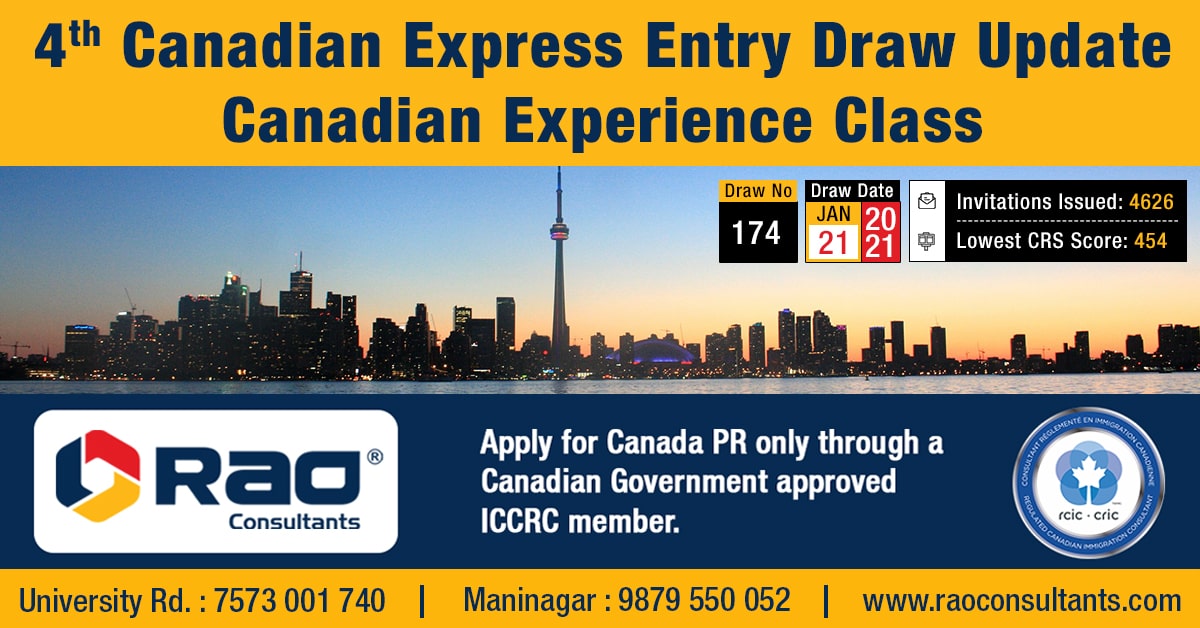
Canada kicked off to meet the target immigration level for 2021. The latest updates on Canada Express Entry Draw held on January 21, 2021, the Canadian government invited 4,626 candidates to apply for permanent residence (Canada PR). The draw considered Canadian Experience Class with a minimum CRS score of 454. This was the fourth Express Entry draw of 2021 and the second within a week held by IRCC.
Since the launch of the New Year, Canada has been issuing the old-styled ITA system by issuing invitations to apply for the PNP and Experience Class distinctly. IRCC is seeking to complete a target of 110,000 immigrants for Canada PR within 2021.
Highlights:
This is the fourth and bigger Express Entry draw of 2021
The first draw of the year was held on January 6, 2021
Canada prepared to welcome over 4 lac immigrants each year till 2023
More than 60 percent of fresh immigration will be under the Economic Class
Express Entry Draws in 2021
Sl. No.
Draw No.
Invited
Date of Draw
CRS cut-off
ITAs issued
1
#171
PNP
6-Jan-21
813
250
2
#172
CEC
7-Jan-21
461
4750
3
#173
PNP
20-Jan-21
741
374
4
#174
CEC
21-Jan-21
454
4626
What is the Canadian Experience Class (CEC)?
The CEC is an immigration program under express entry that permits candidates to apply for Canada PR. A qualified candidates should have minimum one year of full-time skilled work experience in Canada.
What is the Express Entry?
Express Entry is an immigration system executed by Canadian immigration authorities (IRCC) which manages skilled worker applications under Federal Economic programs. This contains the Federal Skilled Worker Program, the Federal Skilled Trades Program the Canada Experience Class and parts of the Provincial Nomination Programs.
What are the Express entry programs?
There are three major types of Canada’s immigration application management system for federal economic-class programs through the Express Entry system.
Federal Skilled Trades Program
Canadian Experience Class
Federal skilled Worker Program
Applicants in these plans, as well as certain PNPs, are assumed a score established on the Comprehensive Ranking System (CRS).
What is Comprehensive Rating System (CRS)?
The Comprehensive Rating System (CRS) is used by the Express Entry System to mark candidates who can apply through the federal government’s Skilled Worker Programs. The points you acquire from CRS include a crucial set of up to 600 points and a set of up to 600 additional points.
How does Express Entry work?
Step 1: Create your accurate Express Entry Profile
Step 2: Submit your profile in the Express Entry pool
Step 3: Accept an invitation to apply (ITA)
Step 4: Apply for permanent residence (Canada PR)
How We Can Help You?
In order to obtain an invitation from express entry, you have to be chosen from a pool of candidates who are competing for an invitation. We are here to make your profile most eligible for the invitation. We will assess your case, highlight the finest features of your application, and make sure that you have accomplished the top qualified marks! Your probabilities of getting an invitation are maximized.
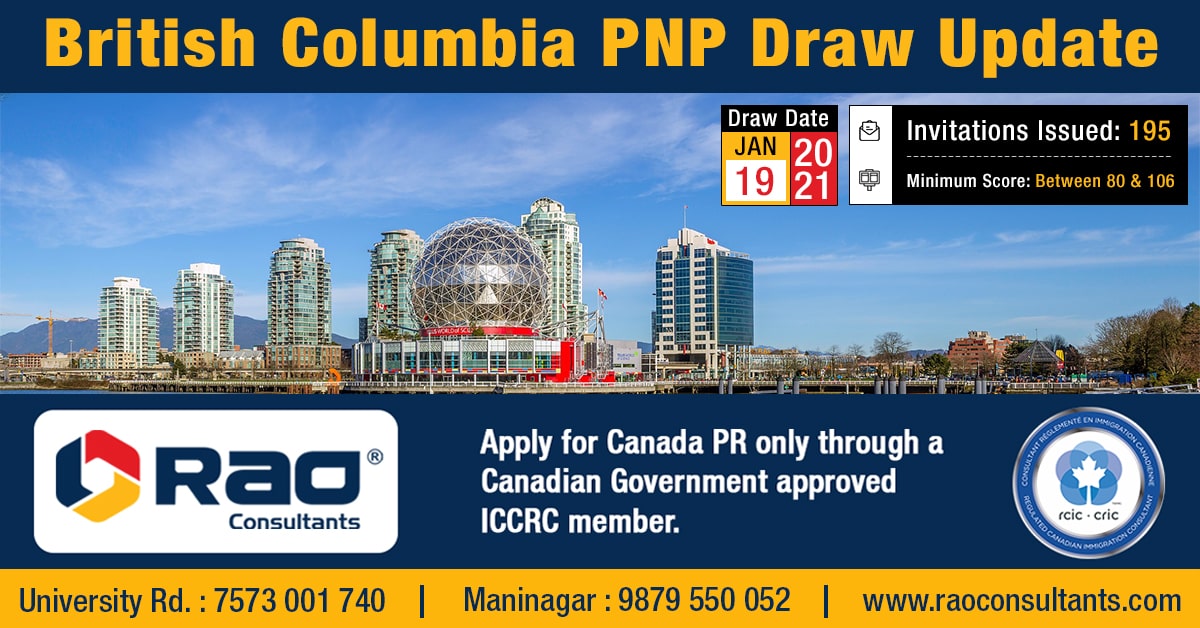
Canada’s westernmost province, British Columbia (B.C) issued 195 invitations to apply for Canada PR Consultants, to Skilled Worker and International Graduate candidates. In the latest draw held on January 19, BC PNP targeted applicants from different categories specifically Skilled Worker, International Graduate, and Entry Level and Semi-skilled worker. The lowest score for this draw varied subject to the subdivision and ranged between 80 and 106 points.
BC PNP has invited 443 immigration candidates to apply for a nomination so far in 2021.
The Breakdown of the Subcategories:
Skills Immigration: Skilled Worker: 96
Skills Immigration: International Graduate: 96
Skills Immigration Entry-Level and Semi-Skilled: 80
Express Entry BC: Skilled Worker: 106
Express Entry BC: International Graduate: 103
Note: Those who got invitations have 30 calendar days from the date of invitation to file a complete application. The ITA received doesn’t assure a nomination for the applicants.
Why British Columbia (B.C.) in Canada?
British Columbia (B.C.) is one of the most engaging spots to settle in Canada. There are abundant explanations that make B.C. an absolutely attractive area to work, education and life.
High Standard of Living: Canada is one of the world’s best nations to live in.
Excellent Health Care: Canadian citizens are allowed to access all the benefits of free medical services.
Competitive Wages and benefits: Owners in BC provide employees with prolonged advantages and tactics, along with complete medicinal and dental treatment options.
Diverse Culture: Folks from several societies call B.C. their home, Multiculturalism invites people throughout the world.
Rich Cultural Heritage: Around 200,000 ethnic people have been living in B.C within the unique geography of the province for over 10,000 years.
Range of Workplaces and Industries: You can have multiple choices of workplaces in B.C including horticulture, development, ranger service, wellbeing and assembling.
Safety in B.C.: Lowest corruption rates and practical guiding principles make B.C. the most secure place to live.