Experience the German Job Equation: High Salaries + Work-Life Balance = Your Dream Career
Germany is highly desired by foreigners seeking employment due to its abundant opportunities for talented individuals. The job seeker visa is among the various immigration options available, enabling foreign nationals to enter Germany and search for employment within a designated timeframe. If successful in securing employment during this period, individuals can proceed to apply for a work vis and obtain a residence permit.
Nevertheless, it is essential to assess your eligibility for the Job seeker Visa and familiarize yourself with the application requirements.
The GERMAN ADVANTAGE:
Work in a Dynamic Economy and Enjoy a High Quality of Life
The German Job Seeker Visa is a type of work visa designed for individuals seeking employment in Germany. Once granted this visa, you’re permitted to reside in the country for a specific duration, typically around 6 months, during which you can search for job opportunities. After successfully securing employment, you can then apply for a work permit, allowing you to remain in Germany for the long term.
NOTE: If the person has already found employment and posses a valid contract, then in that case they do not need to go through the process of obtaining a job seeker visa. Instead, they can directly apply for a work visa based on their Job offer.
Your Ticket to Germany: Meet the Eligibility Criteria for a Job Seeker Visa
In order to be eligible for the job seeker visa, you must fulfil the following conditions:
Your AGE must be 18+
You must possess a BACHELOR’S DEGREE or higher in subjects related to STEM (From a recognized University)
You must have minimum 5 years of WORK EXPERIENCE in an occupation that has high demand in GERMANY’S LABOUR MARKET
You need to show SUFFICIENT FUND to prove that you can stay in Germany
A MEDICAL COVERAGE PLAN.
Accelerate Your Career Journey: Discover the Advantages of a German Job Seeker Visa!
Germany stands as the leading economic force within the European Union and ranks as the fourth largest economy globally, trailing only the United States, China, and Japan.
Boasting an impressively LOW UNEMPLOYMENT RATE of 2.9%, the nation accommodates a workforce of 45.5 MILLION INDIVIDUALS, while also hosting the highest count of cross-border commuters across Europe.
Germany is recognized as one of the leading nations globally when it comes to providing generous paid vacation time, securing a spot among the top five countries.
No IELTS or German Language required
Occupation In Demand in 2023
Occupation
Average Yearly Salary in EURO
Computer science / IT and software development
85,800
Electronics engineering
60936
Mechanical engineering
62000
Account management and business analytics
55000
Nursing and Healthcare
33654 to 65000
Civil engineering and architecture
62466
Take Charge of Your German Job Search: Applying for a Job Seeker Visa Made Easy!
To apply for a job seeker visa in Germany, you must follow the steps below:
Call us and check your eligibility for Free!
Find us on Google and come to the nearest branch to apply through us.
Instead of jumping straight to the reasons why IELTS is important, let us first have a brief about what IELTS is all about? As many of you might know IELTS (International English Language Testing System) is a one of the most popular and a standardized tests of English language to assess your language proficiency in order to get you into a foreign country. It. A decent IELTS score is imperative and one of the major perquisites if you are a student planning to pursue your further studies abroad in countries like Canada, USA, United Kingdom, Australia and New Zealand or if you are the one who aspires to work or settle overseas. The IELTS test is jointly administered by IDP, British Council and Cambridge Assessment English. Let us now go through the top 10 reasons why IELTS is important and how acing the test can make you reap astonishing benefits:
1) Primary stride to study abroad
The first and foremost step towards fulfilling your dream of studying abroad in countries such as Canada and Australia, is to achieve a good score in the IELTS test. You are halfway there once you are through this. Everything takes over from here. Now you know how important IELTS is.
2) The IELTS test is recognised world-wide
IELTS is accepted in 140 countries, by more than 10,000 institutions across the globe with 3,400 in the U.S alone. This makes it the most preferred foreign education entrance test among students everywhere. Above four hundred thousand (400,000) students took the IELTS test the previous year and the number just keeps escalating by the day.
3) Enhances your English Language skills
The IELTS test format has been structured in such a way that it becomes easier for you as the test takers to gauge your proficiency level of English language in comparison with the native English speakers, thereby assisting you to learn the language better and improve your language skills and fluency.
4) Get to learn various accents
While considering taking IELTS test, you come across different accents of the English language. There is peculiar difference between British, American, and Australian accents which you as a non-native speaker of the language are not aware of. But when you prepare for IELTS, you encounter these accents especially in the listening module of the test leaving you prepared for identifying it at the basic level and helping you learn them over a short period of time.
5) Provides you with a real-time experience
The IELTS Test is intended to integrate real-life situations through its speaking module where you directly interact with an examiner. It is a private meeting between the two of you, i.e., the candidate and the examiner. It is an ideal situation which allows you to deal with actual challenges you might run into while studying abroad.
6) Serves your immigration purpose
If you are planning to migrate to a foreign country like Canada, Australia, Australia or New Zealand, then the General training module of the IELTS test with requisite score is required for you to be eligible to process your immigration file and get you permanent residency.
7) Opens doors to work opportunities globally
It goes without saying that you get your due in terms of ample growth opportunities and good remuneration when you work at an organisation in a foreign country. Those who wish to work abroad needs to appear for the IELTS General training module and acquire a decent score to get offers from the employers.
8) Two alternatives of the test to choose from
While you plan to take the test, you can select from two of its options: Paper-based IELTS or Computer-delivered IELTS. Without any change in the test format and extra cost, the Computer-delivered IELTS offers multiple date availability option which is almost every day of the week up to 3 times per day.
9) Quicker results with higher accuracy
The IELTS test results are a measure of fair, accurate and highly reliable assessment of your English language proficiency level because the test is meticulously formulated by the language experts of countries such as the USA, the UK, Canada, Australia and New Zealand.
10) Administered by reliable bodies
The IELTS test is collectively managed by IDP, British Council and Cambridge Assessment English. All of them are extremely trusted organisations that are known to render academic brilliance and traditional understanding.
It is best advised to seek coaching for IELTS from a professional to gain the maximum results. If you hail from Ahmedabad, try reaching out to the best IELTS coaching in Ahmedabad.
The concept of foreign education has been gaining a lot of momentum from quite some time now. Students these days highly prefer to study in Canada after completing their Graduation. It is imperative to search about topped ranked universities when it comes to selecting the best course for yourself. After ticking the university selection box, you also need to take into consideration a bunch of various other parameters like the course duration, credibility of the course, the fees structure, about the faculty and the score requirement of different foreign education entrance exam such as IELTS, PTE, TOEFL.
Why is Canada one of the most popular and sought after destinations for studies after graduation?
Universities of Canada are well recognised worldwide considering the quality of their teaching standard and the research based post graduate programs they offer. Their educational curriculum gives paramount significance to practical projects which are industry-relevant including internship period to provide the students with hands on experience of the on field work. One cannot ignore the fact that study in Canada after graduation is comparatively less expensive and also offers more number of scholarships. Last but not the least, Canada has turned out to be a country having cosmopolitan culture with students migrating from every corner of the world. This makes it extremely adaptable in terms of food, language, attire and religion.
Things to remember while applying to study in Canada after graduation in India
Canada, over the past few decades has earned enormous amount of reputation and trust for its exceptional education system and a plethora of graduation, post-graduation and diploma courses it offers. Students from all across the globe aspire to study in Canada after graduation, especially Indians.
Key features of Canadian admission process:
Canada’s Three Intakes –
January
May
September
Among these, May witnesses the least, whereas September receives the highest student intake
Requirements to be met for Studying in Canada after graduation-
They must have acquired 50 percent or more score in their degree exams
A minimum band score of 6.0 in the IELTS test is mandatory to apply under SDS category
Particularly for The Master of Business Administration (MBA) programs, student can apply with or without GMAT score. It is one off the most demanded courses after graduation that offers a wide range of career opportunities to the students.
Courses to Study in Canada after graduation:
It is very crucial what course you select along with the right kind of university as it is going to pave your path towards future. Mentioned below is a comprehensive list of courses to study in Canada after graduation depending upon your eligibility criteria and area of interest.
Master courses in Canada:
Post-Graduation in business, management and finance
Master’s in International Business
Master’s in Artificial Intelligence
Master’s in Data Analysis
Master’s in Computer Science
Master’s in Information Technology
Master’s after MBBS
Master’s in Robotics and Mechatronics
Master’s in Pharmacy
Master’s in Agriculture courses after graduation
Master’s in Nursing courses after graduation
Master’s in Computer Application
Master’s in Dental Surgery
Master’s in Canada after engineering
Medical courses in Canada after graduation
Study in Canada after graduation in Arts:
These courses are specifically designed to cater students who carry keen interest in the liberal arts, social sciences and humanities. Here is a list of courses after BA is Canada:
Master of Arts in Professional Communication
Master of Arts in Media and Public Relations
Master of Arts in Planning
Master of Arts in Anthropology
Master’s in Administrative Science
Master of Arts in Public and Pastoral Leadership
Master of Arts in Inter Cultural and International Communication.
Master of Arts in Conflict Analysis and Management
Diploma Courses to study in Canada after graduation:
In Canada you can apply for a post-graduate diploma after completion of your undergraduate degree program. These courses mainly aim to offer people with a relatable undergraduate degree an opportunity to enhance their employment skills. These courses are a yearlong courses offered by many Canadian universities. Here is a list of diploma courses in Canada:
Diploma in Tourism Management
Diploma is Hospitality Management
Diploma in Culinary Management
Diploma in Business Administration
Diploma in Media Design and Web Development
Diploma in Video Game Design and Animation
Diploma in Network Technician
Diploma in Global Supply Chain Management and International Trade
Diploma in Graphic Design Technology
Diploma in Digital Marketing
Diploma in 3D Modelling, Animation Art and Design
Diploma in Quality Assurance and Regulatory Affairs – Food Pharma and Cosmetics.
Diploma in Cyber Security Specialist
Diploma in Hospitality and Tourism Management
Diploma in Computer Systems Technician
Diploma in Data Analytics
Diploma in Graphic Design Technology
Study in Canada after graduation in Commerce:
Students who have studied mathematics along with commerce stream are eligible to pursue these courses.
Here’s a list of Master’s’ Courses in Commerce in Canada:
Com in Finance
Com in Marketing
Com in Accounting
Com in Taxation
Com in Advertising
Com in Mathematics
Com in Economics – Microeconomics and Macroeconomics
Com in Business Administration
Com in HR Management
Com in Cost Accounting
Com in Journalism
Study in Canada after graduation in Science:
Generally, a Master of Science degree is awarded to students who finish their studies in courses such as Natural Sciences, Social Sciences, Engineering, Technology, Medicine and Health, Mathematics, Informatics etc. The ideal course duration for M.Sc. degree falls somewhere between 1-2 years, but some master’s programmes like Computer Science and Engineering take from 3-5 years whereas master courses in Medicine may take as long as 6 years to complete depending on your area of specialisation.
Here’s a list of Master’s’ courses in Science in Canada:
Master’s in Computer science
Master’s in Molecular science
Master’s in Physical science
Master’s in Health sciences
Master’s in Civil Engineering
Master’s in Public health
Master’s in Environmental and life sciences
Master’s in Applied human nutrition
Master’s in Psychological science
Master’s in Information Technology
Master’s in Mathematical sciences
Master’s in Clinical psychology
Master’s in Electrical and Computer engineering
Master’s in Informatics
Master’s in Chemical engineering
Master’s in Nursing
Master’s in Computer science-Artificial Intelligence
Master’s in Psychology
Master’s in Forensic science
Master’s in School psychology
Study in Canada after Graduation in Law:
Have you ever noticed that both Indian Law and Canadian Law are primarily based upon British Legal System? Did you just finish your LLB and wondering where to pursue LLM (Master’s in Law)? Well, then Canada is the perfect place for doing Master’s in Law because of several benefits. For one, Canada has top law schools in the world. Secondly, the job prospects in the country are promising. Finally, Canada has the best international student policies.
Here’s a list of Master’s courses in Law in Canada:
Master of Law (LLM)
Master of studies in Law
Master of Law in Global sustainability and Environmental Law
Master of Law in International Humanitarian and Security law
Master of Law in Technology
Eligibility Criteria for Students to Study in Canada after Graduation:
There are certain requirements which students need to fulfil in order to be qualified to get selected to study in Canada after graduation.
They must have scored at least 65 percent of marks in Humanities
A minimum 70 to 80 percent marks in Class 12th in either science or commerce stream.
Indian students also need to meet basic English language requirements like IELTS score of at least 6.5 Bands Overall.
List of Documents needed at the time of Application:
Photocopies of 10th, 12th and Graduation mark sheets
Two letter of Recommendation from your previous employer
Two letter of recommendation from your previous professors
A detailed Essay
A well drafted Statement of Purpose (SOP)
A very well-written Resume
Photocopies of your IELTS/GMAT/GRE/TOEFL test scores
Valid proof of Funds shown
Medical certificates
Any certificates awarded at a state or national level
What are the Job prospects of Studying in Canada after Graduation?
Upon finishing your Master’s degree from Canada, you are eligible to work there for the same amount of time as your Master’s course. In order to extend your work period, you need to apply for a particular type of programme called the Post-Graduation Work Permit Programme (PGWP) within a 90 day time frame right after the official completion of your course. Since Canada offers abundant work opportunities lately, international students must be able to find a suitable job quite conveniently. The salary structure is different with respect to the type of work you choose and the related field with Information and technology, computer science, scientific research, Oil, petroleum and renewable energy being the highest paid jobs. However, the average salary for an entry-level job in Canada falls somewhere between CAD $50,000 and CAD $60,000 per annum.
How much Funds do you require for Living Expenses in Canada?
The living expenses in Canada depend upon various factors like which city you choose to live in and the kind of lifestyle you wish to maintain. Generally you need approximately CAD $ 10,000 which INR 5 to 6 lacs per year to cover the living expenses. But if you prefer to stay in cities like Toronto and Vancouver, your living expenses are definitely going to soar. However, you have options of taking up part-time jobs to meet your living expense there.
International students who are full-time students with work permit have the liberty to work for 20 hours per week off-campus while pursuing their studies whereas they can work for full-time during their summer and winter breaks. It is mandatory for International students to have Health insurance in Canada. So students also need to arrange to pay for their health insurance especially when they are studying in Ontario, Nova Scotia, Manitoba, Quebec and Prince Edward Island. Nonetheless, they are covered under the health care plans in provinces like Alberta, British Columbia, Labrador, New Brunswick, Newfoundland and Saskatchewan.[/vc_column_text][/vc_column][/vc_row][vc_row][vc_column][vc_toggle title=”What is the scope of studying in Canada after graduation?”]Skilled professionals like engineers, doctors, Nurses, lawyers etc. are in high demand in Canada. So, your post-graduate degree along with the practical experience in the relevant field will bag you your dream job.[/vc_toggle][vc_toggle title=”What are the types of work permit for international students in Canada?”]International students studying in Canada after graduation for Master’s degree and want to work there have to apply for Openwork Permit. This allows you to work for employers under particular circumstances. Employer-specific work permit is issued based on the employer, the type of work, location of work and work duration.[/vc_toggle][vc_toggle title=”Which types of exam do you need to take for studying in Canada after graduation?”]If you are not a native speaker you need to take up either of the test; IELTS, TOEFL. Apart from this, for post graduate programs may you also need to take up GMAT.[/vc_toggle][/vc_column][/vc_row]
Germany is emerging as a new hotspot for international education among students all over the world. Going by the Federal Republic Statistic Office data for the year 2020, German universities and colleges have approximately 7 million students studying with them which has risen by 3.1 % in comparison with the previous year. It stands on the fourth position when it comes to being on the list of the most preferred countries for foreign education. There are reasons aplenty that are accountable for this amount of popularity.
Reasons to study in Germany
Owing to its world renowned universities, insightful history, art museums and sprightly night life, enormous number of international students are choosing Germany to pursue their qualifications which is increasing with each passing day.
German degrees hold immense accreditation from recruiters all across the globe. The country has 400 plus higher education universities with more than 19,000 diverse study programs. This huge spectrum of programs includes courses such as Medicine, Management, PhDs, Engineering, Robotics, etc. to name a few. Moreover, a new and advanced international study program is introduced every year into the curriculum. On top of this all, both German and foreign students since 2014 have been paying only a minor amount of semester fee making the study programs practically free.
Top 10 universities to study in Germany
You will be pleased to know that below mentioned ten of the German universities are among the top 100 universities world-wide as ranked by QS World University Rankings, also published by the Times Higher Education (THE) magazine.
Technical University of Munich
Ludwig Maximilian University of Munich
Ruprecht Karl University of Heidelberg
Humboldt University of Berlin
KIT, Karlsruhe Institute of Technology
Free University of Berlin
RWTH Aachen University
Berlin Institute of Technology
Eberhard Karls University of Tubingen
Albert Ludwig University of Freiburg
Broad Spectrum of Study Programmes
Due to abundant, affordable and top-ranked universities in Germany, fortunately, there is a wide range of study programmes for each one of you irrespective of the level of education you are at. These programmes include:
1) Engineering:
Drawing approximately 25% of foreign students or above 70,000 international students towards Germany, Engineering course is substantially one of the most popular programmes to study in Germany. Various streams of engineering that you can apply for are automotive engineering, Mechanical engineering, Electrical engineering, and Automobile engineering amongst many others. Technical University of Munich, RWTH AACHEN and Karlsruhe Institute ofTechnology rank highest in almost every branch of engineering in the country. Furthermore, Germany’s automotive industry is perchance the largest employment provider in the country with a labour force of more than 70,000.
2) Business Management:
Not too far behind engineering, management studies probably secure the second position amid the best courses to study in Germany. Conferring to foremost FT and QS rankings, Germany is not only known for its full-time MBA programmes but also holds a strong position in offering top class executive MBA courses. Some of the best business schools to take up MBA courses in Germany are Ludwig Maximilian University of Munich, RWTH Aachen University, and WHU-Otto Beisheim School of Management.
3) MBBS:
Germany takes immense honour in being considered to have a very modern yet internationally esteemed medical system and is home to some of the best medical schools worldwide too. Nonetheless, opting for a MBBS course to study in Germany is anything but pricey along with higher quality education. This attributes to making the country one of the most desirable choices among medicos across the globe. Since the MBBS course in Germany is delivered in German language, it becomes mandatory for international students to have a knack of it beforehand. Consider top universities like Heidelberg University, RWTH Aachen University, Witten/Herdecke University, Magdeburg University and few more while enrolling in to a medical course in Germany.
4) PhD:
Contrary to the conception that procuring a PhD in Germany for international students is complicated, it rather is not. Recent admission data reveals that nearly 3, 80,000 students are pursuing their PhD degrees in Germany which includes around 10% foreign students. More so, Indian students make the second most group of foreign students to study in Germany for PhD courses. PhD students require a well-structured atmosphere in order to obtain an enriching experience with respect to their studies. World-class education standards, seasoned faculties, state-of-art infrastructure facilities, special emphasis on practise are few of the requisites for PhD students. Unlike medical courses, PhD courses are taught in English. Universities like LMU Munich,Technical University of Munich, Heidelberg University, Humboldt University of Berlin and University of Freiburg are the five best ones you must aim for your PhD studies in Germany.
5) Computer Science:
Computer science course is one of the most prevalent and coveted courses to study in Germany as the country is considered to be one of the world’s foremost book homelands. Many German universities offering computer science studies are ranked among the best universities globally. This field of study comes with higher employment opportunities. Renowned German universities for Computer science course are Technical University of Munich, RWTH Aachen University, Karlsruhe Institute of Technology, Technical University of Berlin, LMU Munich, University of Freiburg, Technical University of Darmstadt, Heidelberg University, University of Bonn and Friedrich-Alexander University of Erlangen-Nuremberg.
6) Masters in Data Science:
Despite being quite challenging, data science is a stream worth considering. It is contemplated as the occupation of tomorrow. In the current world of cutting edge technology, we are in dire need of professionals who can manage to work out intricate statistical data. This has created umpteen opportunities for those who want to study masters in data science. Carrying out masters in data science in Germany is undoubtedly the best choice as the subject is pretty innovative and requires up to date methods and settings which German universities are well equipped with. Some of the best data science universities in Germany include: Technical University Munich, Ludwig Maximilians University Munchen, University of Magdeburg, TU Dortmund, University of Mannheim, University of Hildesheim, University of Applied Sciences Darmstadt and University of Gottingen.
7) Master’s Degree (MS courses):
There are prospects galore for those who aspire to take up MS courses to study in Germany. The universities offer a wide range of master’s degree courses that are imparted in English language with extremely reasonable cost and award-winning prospectuses. They give immense importance to students’ hands-on experience and are undeniably the ones with brilliant future prospects. It is a wonderful opportunity for international students to contribute towards the country’s remarkable academic records by selecting to study masters in Germany. Top universities offering Masters in Germany are Technical University of Munich, Ruprecht-Karls University Heidelberg, Ludwig-Maximilians University Munchen, Humboldt University of Berlin, Technical University of Berlin and few more.
7 Best German Scholarships for Indian Students
Apart from being famous for its high quality education, world class universities, rich history and vivacious culture, Germany is very well known for its excellent scholarship programs too. International students have a chance to choose programs of their interest with negligible tuition fee and low accommodation cost. Here’s a list of top 7 German scholarships for Indian students:
1) DAAD WISE Scholarship Program
College students studying either bachelors or integrated/dual programs from specific Indian universities are allowed to apply for this scholarship in various faculties like Engineering, Natural Sciences and Mathematics, etc. DAAD scholarships are the most popular among others that covers 750 euros as living expense and 1075 euros as travel and health insurance costs for students.
2) Konrad-Adenauer-Stiftung scholarship
This Scholarship is for those having finished the bachelor’s /Master’s degree in their base country and planning to pursue higher studies in Germany. It also considers students with doctorate degrees and focuses more on students with keen interest in politics. The scholarship can be either reimbursement of tuition fee up to 500 euros or a monthly stipend of 1100 euros for 3 years and is mainly for students hailing from developing countries.
3) Heinrich Boll Scholarship
This program is for international students who have passed their university entrance exam and have selected any subject from the scholarship’s Master’ or PhD courses. The amount offered for Master’s courses is 850 euros every month alongside extra allowances. For PhD courses, the amount offered is 1000 euros per month with additional 100 euros for travel expense.
4) Kofi Annan MBA scholarship
This particular scholarship offering a 2 year Masters in Management course or a 1 year full-time MBA course requires the foreign students to have completed their bachelors with high academic score. They are also required to have English language proficiency and a strong yearning to contribute towards the growth of their home country. Few candidate get advantage of full tuition fee worth 25000 euros for MIM and 43000 euros for MBA courses. It also assists with other services like visa, transport, accommodation, insurance and networking.
5) ESMT Women’s Academic scholarship
This scholarship program invites female students from all across the world applying for a full-time MBA course in European School of Management and Technology (EST). The requirement to avail this scholarship is to have a minimum score of 700 in GMAT exam and the selection is based on the essay which is submitted at the time of application. The value of this scholarship is 15,000 euros.
6) Goethe Goes Global Scholarship
The primary purpose of this scholarship program is to augment and back the career of the students. It is an novel project especially for Master’s studies allowing shortlisted candidates to pursue their studies at the Goethe University in Germany. Around 20 scholarships are provided each year for foreign students who have successfully done their bachelor’s. The value of the scholarship is 1000 euros per month until course completion.
7) EMS Undergraduate Scholarship
EMS, The European Management School, proposes this scholarship program to those who want to attain a Bachelor’s degree in Germany. The aspiring students must have an outstanding academic as well as social achievements track record from their schools. This program basically eases the undergrads towards their professional career ahead leading them to gain a respectable business designation in Germany and other countries too. It offers 50% discount on the tuition fee alongside a global exposure to enhance the students’ persona.
Frequently Asked Questions:
Q:Do I need to take IELTS or TOEFL test in order to take up an English-delivered program?
Ans: Unless you are a native speaker, you will need appear for either TOEFL or IELTS test to study in Germany. However, if you have already finished an undergraduate degree in an English-taught course and are applying for a post graduate degree, you will not require to pass any of the two exams.
Q:Is it allowed for international students to work while studying in Germany?
Ans: Part-time work is allowed while you are pursuing a full-time course in Germany. The working days are restricted to 120 days of full time work or 240 days of part time work. But, you cannot be self-employed or do any free lancing work while you are working during the legally permitted time duration. Nevertheless, if you are a full time student from member states of the EU/EEA, you can work for 20 hours max per week.
Q:Do I have to learn German language if my study course is in English?
Ans: If your entire study program is going to be delivered in English, then it is absolutely not necessary for you to be proficient at German Language.
Conclusion:
This article sums up almost everything that you need to know if you wish to study in Germany for graduation or post-graduation courses in variety of streams. In addition, it also gives you an insight in to the basic information about the culture, infrastructure, night life, medical facilities of the country and more importantly about the top most German universities recognised and ranked globally along with the best scholarship programs which you can take the advantage of. I hope this helps. Good luck on your decision to Study in Germany!
*All the Statistical data provided in the article is with reference to the information available on the Internet
Studying in Canada as a pathway to Canadian Immigration is considered to be one of the most feasible among very many options by umpteen students across the globe. Canada, over the past few decades has taken the centre stage when it comes to foreign education and immigration. This beautiful country offers a plethora of opportunities to aspiring candidates who hope to either pursue foreign education, work abroad or even settle outside of their native country. Deciding to study in Canada will not only give you the pathway to Canadian Immigration, but also provide you with an access to world class education as it is home to the top ranked colleges and universities for under grads and graduates respectively. It gets very convenient for international students to quickly acclimatize to the different aspects of the country due to its contemporary infrastructure, latest technological advancements, cosmopolitan culture and more.
Why consider Study as a Pathway to Canadian Immigration?
Among multiple reasons to choose Canada for receiving international education, some of the most lucrative ones are as follows:
Opportunity to work while studying in Canada– Aspiring students have plenty of job opportunities when they are pursuing their studies in Canada. This will not only help them gain Canadian work experience but will also benefit them in various aspects like enhancing their language skills which will eventually help in scoring higher bands at the time they apply for PR in Canada, adapting to the work environment of the country, mingle with the people around, acclimatize to the weather etc. Having minimum of one year work experience in their home country along with Canadian education and the current work experience, all put together will definitely increase their chances of getting PR under various immigration programs.
Open Work Permit for spouse– International students who select Canada as their study abroad destination can also accompany their respective spouses on the basis of Open Work Permit Visa. This will allow the spouse to work in Canada and gain valuable job experience. On these grounds, you can apply for Canada PR which can lead to greater chances of getting yourself a Canadian PR status.
The advantages of Post Graduate Work Permit- Post Graduate Work Permit is an efficient path when it comes to working in Canada after finishing studies over there. International students post their course completion are allowed to work in Canada for up to 3 years on the basis of PGWP Visa. By bridging this Canadian education into meaningful full-time work experience, it’s a golden chance for candidates to attain Permanent Residency in Canada as Canadian work experience adds to the CRS score further.
4. Aspiring candidates fall eligible to apply under the below mentioned Canadian permanent residency programs-
Canadian Experience Class (CEC): This program is one of the fastest routes towards acquiring Canadian permanent residency which is functioned by the Express Entry immigration system. It is inevitable to have a minimum of 12 months of uninterrupted, full time skilled work experience or an equivalent amount of part-time work experience in Canada within the provided 3-year time period. The most important thing to consider while trying to be eligible for CEC program is that the work experience attained while studying full-time does not count.
Federal Skilled Worker Program (FSW): This program can be considered by some of the foreign student graduates where they do not require to have Canadian work experience like CEC. However, the FSW program does ask for the applicants to hold a minimum of 12 months of continuous full-time or an equivalent part-time work experience received from any other country. It works on the basis of merit by using the points-based Comprehensive Ranking System (CRS) score which shortlists the candidates with highly competitive profiles and who comply with the eligibility criteria of the program requisites. This makes FSW a great pathway to Canadian Immigration.
Provincial Nominee Programs (PNPs): Unlike the two above mentioned Canadian immigration programs, Provincial Nominee Programs (PNPs) work in a way where each of Canada’s provinces run its individual immigration program in order to cater to the needs of that particular province. Candidates who have some specific type of link to a particular province like finishing their studies from that province or work experience of that province are more likely get preference over others when applying for its PNP program.
Quebec Immigration Programs: There are a couple of main types of this program.
1) Quebec Experience Program (PEQ)
To qualify under this, international students need to either have finished their studies or are in their final 6 months of completing their studies at a university in Quebec. Also, they should exhibit their intermediate to advanced French Language speaking fluency to be eligible.
2) Quebec Skilled Worker (QSW)
This one is for the foreign students who have either finished their educational courses or are currently enrolled in to any of the study programs in the province. Dissimilar to PEQ, QSW does not ask for French language fluency but students need to be fulfilling the minimum score requirements set by the program.
5. Benefits of taking up Medical Courses– Being a Medico in Canada always have an edge over the other aspirants. The demand for doctors has increased three-fold in Canada. Medicine is probably the single most sector of the Canadian Labour Market where vacancies for fresh jobs are added almost every day, especially after the COVID-19 Pandemic. The overall Employment for Surgeons and Physicians is anticipated to rise by nearly 13% in Canada in the coming years.
Start off with Study as a Pathway to Permanent Residency Status in Canada.
International students who are either planning to attain their further education in Canada, currently studying there or have finished their education most of the times attempt to apply for Canadian Immigration to permanently reside in Canada with respect to the requirements of the Canadian Immigration Program for which they choose to apply. The most favourable facet of the Canadian Immigration Program is that candidates can apply for a Canadian work permit as well Canadian permanent residency simultaneously which is known as “dual intent”.
Which Programs offer Work Permit for International students in Canada?
Working in Canada while you are studying is possible for you provided your study permit mentions a condition which implies that you are eligible to work on campus or off campus. You can begin to work in Canada once you commence your studies in addition to other requirements. You are not allowed to work before starting or after finishing your study program.
It is vitally important for you to be well aware of the fact that in spite of having a student visa and the permission for international students to work in Canada, certain program refrain from allowing you to work there. These programs particularly include Language Programs under which you are not allowed to apply for a work permit while studying in Canada.
Gladden yourselves!
Despite these constraints, there are programs at your rescue which grant you a work permit while studying in Canada so that you have exposure to multiple international student job possibilities which you can take advantage of and apply to work for.
These programs include;
Vocational Programs- These types of programs are quite popular among the natives and non-natives (Foreign students) of Canada. Such programs are designed to condition you with specific skills which are relevant to the Canadian Labour market. You can proper training and practise for the same. Upon successful completion of the program, you become a certified degree holder in that skill which enables you to straightaway delve into the job market.
CO-OP Programs- This is one of the most luring alternatives for international students who are considering study as a pathway to Canadian immigration. These are definite programs structured for you to have work experience in different sectors before you face the heat of the real work scenario. To obtain this, you will receive an academic training and practice by the companies in the sector you elect to work for. A co-op program is apt if you are worried about having insufficient work experience. This feature of the program makes it most sought after option for international students to dive into the Canadian Labour market.
University Programs-These type of programs offered by Canadian universities are meant for undergraduate, masters and doctoral degree students. Several private and public institutions are available for international students to gain education in such diverse careers. Technology, Finance and Business sectors are highly recommended in the cities of Vancouver and Toronto respectively. Certain factors like enrolment requisites of universities and cost of living in such areas play a vital role though.
Different types of Work Permit available for International students.
International students who have enrolled themselves in a Canadian university or institution with a valid study permit have multiple job prospects for working in Canada. While not all jobs ask for a work permit from foreign students, majority of the off-campus jobs do necessitate a work permit, however few of them are subject to specific work permit/LMO exemptions. Given below are the options of work permit for international students:
On Campus Work Permit- Foreign students pursuing full time education at a Canadian private or public college or university with a legit study permit do not necessarily require a Canadian work permit to work on campus.
Off Campus Work Permit- International students who are studying full time in Canada with a valid Canada study permit may possibly be approved to work off the campus with the condition that their institution is a part of the off campus work permit program through Citizenship and Immigration Canada (CIC).
CO-OP and Internship Work Permit- This type of work permit is for those international students whose study program in Canada form a crucial part of the planned employment as per their academic institutions. The work duration of this program may comprise of up to half of the time duration of their study course.
Post-Graduate Work Permit- To qualify for this particular type of work permit, foreign students should have finished their graduate degree for any course from a Canadian university with a minimum time period of eight months. The validity of the Canadian work permit is mostly similar to the validity of your Canadian study permit.
Work Permit for the Spouse of a Foreign Student- If an International student is accompanied by his/her spouse with a legitimate Canadian study permit, then the spouse is also permitted to a Canadian study permit or an open work permit without requiring an employment offer or Labour Market Opinion.
Canada strives to ease the amalgamation of international students into the Canadian community, thereby offering ample work opportunities to students who are in search of work in Canada. These work permits for part time jobs enable foreign students to attain valuable work experience while allowing them to support their expenses while studying in Canada. Studying and working in Canada will not only help you establish business contacts for the future but will also serve as a pathway to Canadian Immigration.
Frequently Asked Questions.
What is Post Graduation Work Permit (PGWP)?
After finishing their studies in Canada, foreign students seek job opportunities to work there. The Post-Graduation Work Permit (PGWP) is an open work permit which allows such students to work in any Canadian organisation within the extent of the permit. Moreover, you don’t have to have a job offer from a Canadian employer beforehand neither do you need a Labour Market Impact Assessment (LMIA) from the Employment and Social Development Canada to be eligible to apply for a PGWP.
What is the Eligibility criteria for a Post-Graduation Work Permit?
As an International student, to be able to apply for Post-Graduation Work Permit (PGWP), you need to meet certain eligibility criteria which are as follows:
Your study permit must have been valid at any given point in the previous period of 180 days i.e. 6 months, must hold a valid visitor record.
You must either have submitted an application for your study permit extension or to modify your status to ‘visitor’ before expiry date of your study permit while your application is yet to be approved.
You must have successfully accomplished a study program offered by a Designated Learning Institute (DLI) in Canada.
The duration of your study program must have been of at least eight months which could grab you either a degree, diploma or a certificate.
During the entire course of your study program, you must have been a full time student in Canada, barring the permitted leaves of up to 150 days and a part time final semester.
You must have graduated from any of the following four categories:
A public post-secondary school like a college, a trade or technical school, a university or a CEGEP in Quebec.
A private post-secondary school in Quebec that follow the exact rules as the public ones in Quebec.
A private secondary or post-secondary school in Quebec which offers 900 hours or more to be qualified as a vocational studies diploma holder or similar recognition.
A Canadian private school that can assign degrees under provincial law with respect to the condition that you have enrolled yourself in a study course which will fetch you an authorized degree issued by the province.
How many hours can international students work in Canada?
At the time of your regular school term or semester, you are allowed to work for up to 20 hours in a week. It depends on you whether you want to utilise these hours for only one job or more than one provided you abide by the conditions of your study permit. However, you are eligible to work for full time if you are on a scheduled break like summer and winter holidays or a spring or fall reading break. Apart from this, you can even work overtime that adds up to more number of hours. In order to work full time before and after the break, it is necessary for you to be a full time student at a Canadian university. You cannot work in a break which falls before the beginning of your very initial semester.
Conclusion:
Taking all the above mentioned aspects in to consideration, considering study as a pathway to Canadian Immigration is the most viable alternative for international students all across the globe to obtain highest grade of education, gain international work experience and eventually settle down and make Canada your home. This country has so much to offer in terms of well-established infrastructure, world class medical facilities and insurance policies, post study work permits, open work permit and not to forget the top-notch education system. All these attributes make Canada a perfect place for anyone aspiring to receive foreign education and settle abroad, which is exactly why it is the most favourite study abroad destination of students from every corner of the world.
As the worldwide pandemic gradually becoming the new normal, students from across the globe are resuming their plans of studying abroad once again. If you planning to study in Canada and are scheduled for the next available May intake in 2023, you must be well-informed by reading this article. This blog will inform you about popular programs in Canada for May 2023 intake, When to apply for May 2023 intake in Canada, and all about the last dates to apply for May 2023 intake in Canada.
All about May Intake in Canada:
May Intake is similarly well-known as spring intake or summer intake in Canada. Usually, that opens in May. We shall discuss an effective timeline that you can follow or take inspiration from, to initiate your process for applying to colleges and universities in Canada.
Who Can Apply?
Education Qualification
The minimum qualification norm is to be a graduate with a 50% score from a UGC or AICTE recognized university. However, there are certain exceptions.
The graduation degree has to be completed within the specified time with no-year back.
The student should not have more than 10 backlogs in his/her graduation period (depending on course, college and category).
Why do International students love to study in Canada?
Canada essentially covers all the resources to help students to succeed whatever they have determined for a prosperous career. Here are some valued purposes for why students love to study in Canada! Let’s look into the different factors and elements that you need to consider and complete for an efficient, effective, and stress-free admission process.
Canadian Universities offers Variations of Educational Programs:
In Canadian universities, you can apply to any field of education you can imagine. Universities offering several courses from Arts, Languages, History, to Management and Engineering. In modern times, some of the most popular study options where international students chose to enroll are Business, Environmental Science, Social Sciences, Engineering and Technology, Medicine.
Top 10 Universities in Canada
Based on QS World University Rankings: 2020
Name of the University
Canada Rank
Global Rank
University of Toronto
1
29
McGill University
2
35
University of British Columbia
3
51
University of Alberta
4
113
Université de Montréal
5
137
McMaster University
6
140
University of Waterloo
7
173
Western University
8
211
University of Calgary
9
233
Queen’s University
10
239
Affordable Fees with World Class Education:
Education fees at Canadian universities are lesser than those from nations like the United Kingdom, the USA or Australia. University/Colleges’ fees may vary annually, as you will notice differences depending on the province, city or selected program.
Sr.no.
Study program
Average annual fee
1
Undergraduate program
$13,000 to $20,000
2
Postgraduate master’s degree
$17,000 to $25,000
3
Doctoral degree
$7,000 to $15,000
4
MBA
$30,000 to $40,000
Note: The cost of study may vary individually depending upon colleges, course duration, intake and scholarship availability.
Enormous Opportunities for Scholarships:
International students who want to study in Canada can avail plenty of scholarship opportunities from Canadian colleges or universities. The opportunities available to you will depend on your stream of study or research and your native country.
Types of Scholarships in Canada:
Canadian Government Scholarships: Offered by the government.
Non-Government Scholarships: Offered by various NGOs
Institutional Scholarships: Offered by universities or colleges in Canada.
Benchmarks to applying for scholarships in Canada:
Although, the overall eligibility will vary some general requirements that international students must keep in mind are:
Academic excellence: Most of the scholarships are merit-based, which means, financial support will be offered to meritorious students.
Language Proficiency: Since most international students do not have English as their first language, having better language skills or proficiency scores on IELTS exams.
Extracurricular Indulgence: This is often a case with stream specific scholarships, such as programs like social work, etc.
Yes! In Canada, international students have the right to work while they learning. You can work part-time (up to 20 hours per week) during school terms. If your program of study includes work experience, you may be able to work even more than 20 hours during the semester.
Can you call your Family in Canada?
Yes! You can call your family on a visitor visa while learning in Canada. They may be permitted to study or work in the country. Your spouse can also work full time while you are in Canada.
You can stay in Canada after Graduation!
Securing a Canadian student visa offers international students various opportunities to apply for permanent residency in Canada. If you want to remain in the country, you can become permanent residents applying through Post-Graduate Work Permit (PGWP).
Types of study programs
There are two main types of programs available in Canada
Undergraduate programs (UG)
Postgraduate programs (PG)
UG and PG courses further categorized into different types of courses such as:
Bachelor’s Degree courses (4 years)
Master’s Degree courses (1-2 years)
Diploma courses (1-3 years)
PG Diploma courses (1-2 years)
Certificate and Vocational training courses(1 year)
PhD programs
The topmost on-demand categories in engineering are:
Mechanical
Civil
Electrical-Electronics
Chemical
Industrial & Manufacturing
Engineering Management
The topmost on-demand job in IT are:
Information systems analysts and consultants
Database analysts and data administrators
Software engineers and designers
Computer programmers and interactive media developers
Web designers and developers
Dev-Op & Cyber Security Professionals
Post-Graduate Work Permit and Canada PR
Post-Graduate Work Permit (PGWP) is classically approved for the same duration as your studies in Canada. The program allows you to stay in Canada and work up to three years after your graduation. Working for one year in Canada, international graduates may be entitled to apply for permanent residency (Canada PR).
When should you apply for May 2023 intake in Canada?
For the May intake, you can start applying to Colleges in the months from October 2022 to December 2022. Most colleges in Canada will have their deadlines set in the month from October to February for May 2023 Intake. Though, you should be attentive to the university’s website for any updates regarding your Intake.
Categories of student visa:
In Canada the learning organizations are allocated into three categories for a student visa:
SDS (Student Direct Stream) Category: In SDS Category the Academics requirements for a student visa is more than 55% in Last qualifications, whereas in IELTS you should have more than 6 bands overall with 6 bands in each section.
General Category: In General Category the minimum required percentages are 50% and In IELTS you should have more than 5.5/5 Band.
University Category: Under this Category, the students should have more than 60% in their last qualification. The necessities may vary as per the requirements of the University.
Important Stages to Study in May intake in Canada 2023
May Intake 2023 step 1: – Start Now!
Choose the best colleges/universities most suitable for you.
Note down the programs for you that best to your academic and career goals.
Ensure detailed inquiry on the list of colleges.
Each college has its specific deadlines for the May Intake for Canada in 2023, and that should be considered in your planning.
May Intake 2023 step 2: Appear for the Exams
Appear suitable exams as per your university requirements.
Prepare for essential exams like IELTS, two months before the test.
You should be taking your IELTS exam, depending on the course and university necessities
Be prepared for any unpredicted results, in case you want to retake for a better test result.
May Intake 2023 step 3: Start Applying to Colleges:
Search for May Intake colleges in Canada 2023, choose the colleges and Universities before the due dates for the particular institutes. Organize your final application.
Be alert and Apply before the due date.
Step 4: Letter of Acceptance and Interviews:
Do not delay in replying to the college once you received an email from the colleges. Colleges will email you after you apply for the courses.
If you are accepted into a college/university, make a quick decision.
Do not wait for the deadlines to reply, as some of the colleges follow a first come first serve strategy.
You should start preparing to interview as you may face it online.
Step 5: Apply for Student Visa and Education Loan:
Start the visa process: Soon after paid your admission fees, gather all the documents required for your student visa application and proceed further.
Apply for an education loan soon after receiving the letter of acceptance (LOA) as certain processes take time, and you should always consider that before planning for the timeline.
You can apply for an outside scholarship as well, as soon as you get the acceptance letter from the college/university.
Step 6: Be ready to Departure:
Now, you are almost equipped to fly! Book airline tickets.
Most program terms will start in early May, so it is logical to reach Canada before beginning the course.
Before takeoff, collect all the essential papers and their photocopies.
Secure an international Credit / Debit card before departure, and ensure you have clear every checkbox in your pre-departure checklist.
Canada Student Visa Requirements:
You will usually require the following documents for your CANADA Student Visa application:
Valid Passport
Verified copies of 10th, 12th and Degree certificates
Statement of Purpose (SOP)
Certificates of extracurricular achievements
An acceptance letter from your education institution
Evidence of payment
Evidence of financial funds
Passport size photographs
Study Permit and visa
English Aptitude (IELTS)
Additional requirements from your University
Post-Covid-19 Measures Taken in Canada:
Canada has put several measures to protect international students from the pandemic. The country has already begun vaccinating the citizens in high-risk classes. Post-coronavirus recovery actions include a two-stage study permit process and the ability to begin studies online, with this time counted towards the Post-Graduation Work Permit (PGWP). Meanwhile, IRCC has had already been starting procedures as quickly as possible.
International Students are covered under the Healthcare System:
Several provinces allow international students access to Canada’s public healthcare system. All Canadian schools/Colleges provide health insurance policies for international students.
Two other intakes in case you missed the targeted one?
Apart from spring intake, there are two other intakes available for students in Canadian universities.
Fall intake: The Fall intake starts in September
Winter intake: Starts in January; it’s best if you miss the September intake
The Climate in Canada:
Canadians enjoy four different seasons, mainly in the more populated provinces along the US border. The warm season lasts for 3.5 months, from June 1 to September 17, with an average daily extraordinary temperature of more than 68°F. The winter season lasts for 3.4 months, from December 2 to March 15, with a regular daily high temperature under 39°F.
Attentive for Deadline for May Intake Canada:
The final dates to apply for May Intake are usually fall in February. Though, the dates may vary from college to college. Due to COVID-19, a certain flexibility in deadlines of the admission process is provided to the international students.
Conclusion:
The time is here! Studying in Canada is one of the most wonderful and life-changing experiences. Utmost colleges in Canada have a first come first basis admission policy for admission, and you have to start your application process as soon as possible. Awaken for the deadlines for May 2023 intake for Canada and jump accordingly.
How Rao Consultants can help you with the admission and visa process?
As an IRCC approved and primary study visa consultant in western India, We provide you free career forecasting and counseling. Our proficient team of career counselors assists you with an excellent and suitable study program based on your career choice. We provide you with end-to-end support for students seeking to study abroad.
The UK is one of the best selections for learning as it is a boundless blend of societies from around the world. With a long and delighted history of academic distinction, it is student-friendly and among the cream of the crop in almost all segments.
Going to study in the UK is a great approach to expand your knowledge; you’ll catch plenty of backing at institutes, and an opportunity to experience a great student lifestyle. Whatever your comforts, there’s a massive variety of clubs and cultures, as well as a diverse social life on offer.
Benefits of Studying in the UK:
There are three types of benefits of studying in the UK. 1. Academic, 2. Financial and 3. Miscellaneous
Academic:
Degree from UK University is highly reputed internationally.
30% of UK university exploration is ‘world-leading’ and 46% is ‘internationally excellent’ categorized by the Research Excellence Framework.
UK universities are reviewed frequently by QAA to evaluate the ethics of teaching, learning and research to guarantee that set benchmarks are met.
The education system in the UK is the best for law, sciences, management and humanities.
Over 395 universities and colleges that offering over 50,000 UG/PG courses, you can learn whatever you decide.
UK universities have the finest research and teaching facilities.
Highest Student Satisfaction Rating.
Interactive and extremely relevant teaching to the industry with an emphasis on practical knowledge and skills-based methodology.
You can expand your knowledge at the largest library in the world.
Financial:
Numerous scholarships are offered by many organizations and universities.
Affordable housing alternatives, hostels and home-stays are also available.
Part-time work is also allowed while studying in certain colleges.
You can stay in the UK after completing graduation if you hold an employment offer.
Multiple job options across the world.
Miscellaneous:
You can receive free medical treatment by the National Health Service (NHS) if enrolled in a full-time course.
The UK is a unique country as thousands of families from around the world reside here, which offers you a multicultural atmosphere.
In the United Kingdom, you can travel to Scotland, Wales, and Northern Ireland and acquire around the diverse upbringings and lifestyles in each nation.
A student can receive distinctive rates for transportation when you buy passes.
In the UK, you will be as safe as at your home.
Popular Degree Streams in the UK:
Business
Natural Sciences
Engineering and Technology
Medicine
Law
Social Sciences
Sports Science
Media and Communication
Arts
Hospitality and Tourism
Eligibility:
The projected academic requirement is a minimum of 60% GPA in higher secondary to become registered in humanities or arts programs. For science courses, the lowest 70% GPA is essential. You can speak to our counselor for an eligibility check.
Which is the Best Intake to Study in the UK?
The UK universities have multiple intakes but 2 are more popular intakes; Autumn Intake and Spring Intake. The highest intake periods are September/October and January/February in the UK.
Autumn intake: Considered as the main intake, autumn intake occurs in September/October.
Spring intake: More like a secondary intake Spring intakes in the UK occurs during January/February. If you are opting for spring intake, take into concern the UK weather and arrange accordingly.
Summer intake: An additional intake offered by some institutions occurs during May. Remember that the application deadlines for summer intakes will end a couple of months ahead of the intake month.
Top 10 Universities in the UK
Global Rankings
UK Rankings
University of Oxford
5
1
University of Cambridge
7
2
Imperial College London
8
3
UCL (University College London)
10
4
University of Edinburgh
20
5
The University of Manchester
27=
6
King’s College London (KCL)
31=
7
London School of Economics and Political Science (LSE)
49
8
University of Bristol
58
9
The University of Warwick
62
10
Source: QS World University Rankings 2021
Scholarships Available for Indian Students:
If you are an Indian student looking for breaks to study overseas, then you can be offered international scholarships by numerous governments, organizations and specific universities.
Government-funded UK scholarships for international students:
British Chevening Scholarships – The scholarships offer full or part money for full-time graduate programs.
Commonwealth Scholarships for Developing Commonwealth Countries – The scholarships for worldwide students from evolving countries in the Commonwealth.
Commonwealth Shared Scholarship Scheme at UK Universities– The scholarships for global students undertaking qualified master’s programs.
Marshall Scholarships – The scholarships for US students presenting academic merit, leadership potential and ambassadorial potential to learning in the UK.
IELTS Score Required to Study in the UK:
Studying in one of the world’s top 200 universities in the UK required a rigid score. The least requirements for IELTS skills as hereunder.
Courses
English Requirement
UG Programs
IELTS 6 (5.5)
PG Programs
IELTS 6.5 (5.5)
Some colleges are accepting 6(5.5) for PG programs, while some are accepting without IELTS. They accept the students based on the last 3 years’ study medium and results.
Required Documents to University Application:
The official papers commonly required for an application are as follows however, the requirements may vary according to your college and course:
The latest CV
Valid Passport
IELTS Certificate
Copies of degree/diploma certificates
Academic transcripts
Statement of Purpose (SOP)
Letters of Reference (LOR)
How to Start the Student Visa Process?
If you have decided to study in the UK, the next step is to learn about the application process, exploring universities and documents required for entry.
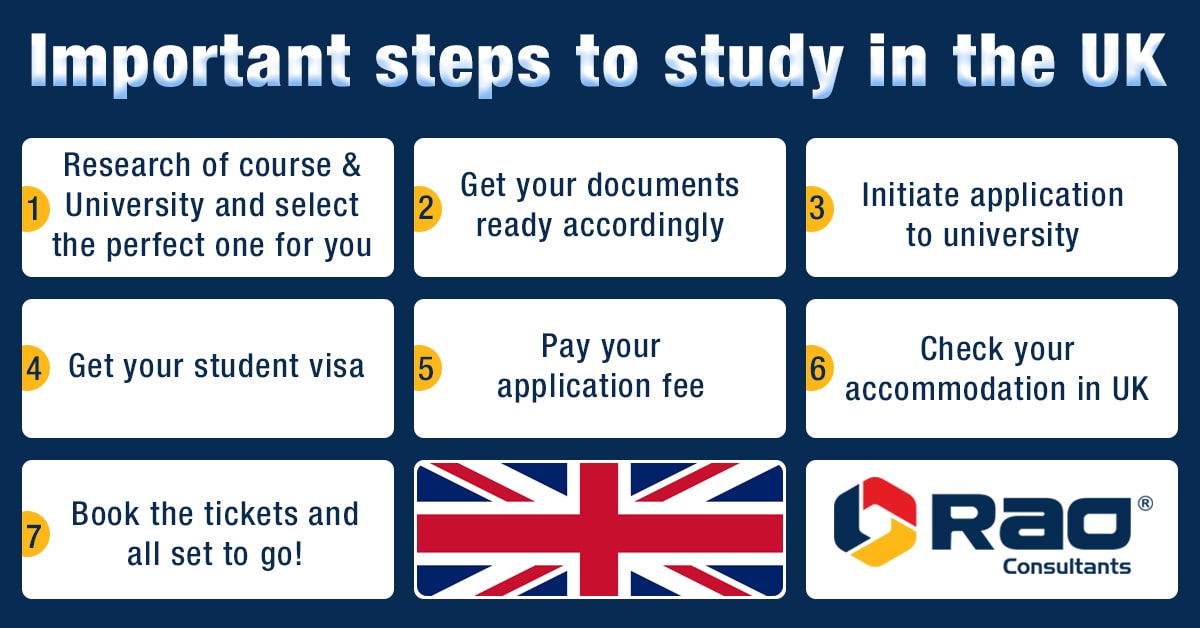
Important steps to study in the UK:
Research of course & University and select the perfect one for you
Get your documents ready accordingly
Initiate application to university
Get your student visa
Pay your application fee
Check your accommodation in the UK
Book the tickets and all set to go!
Appreciate the Life-time Experience in the UK:
The UK offers a treasure-trove of places to visit for fearless explorers. Several standard places to visit in London are Windsor Castle, London Zoo, London Bridge, The Tower of London, Madame Tussauds Wax Museum, Saint Paul’s Cathedral and many more.
How Can You Get PR for the UK after Study?
Upon completing your education, you could get a full-time job. After 5 years of working, you can apply for the ‘indefinite leave to remain’ ILR Visa which provides you the ‘permanent resident’ status. You will also require to pass the Knowledge of Life in the UK test and a recognized English Language test.
Summary:
If you want to expand your horizons and gain worldwide exposure, you must explore the UK as a popular abroad study destination. Over the years immigration has altered the expression of the UK. The excellent educational set-up, top-notch eminent teaching system, quality research, rich heritage, and diverse culture of the UK make it a wonderful place to study. You can also avail the benefits of scholarships, a part-time job and PR for the UK after your student visa.
Get Ready to Succeed!
To know more about UK student & Health and Care Visa or any further assistance in your Visa Application, you can reach us on below-given details. Good luck with your applications!
The majority of the international students choose Canada over other countries as an international destination to pursue their higher studies. Canada has seen a steep rise in Indian students in the past decade and this graph has been predicted to be constantly rising to a significant extent in the current decade.
Why choose Canada over other Countries?
There must be a lot of developed countries out there like the UK, USA, Australia, Ireland, France, etc. who are offering similar courses that you are going to study in Canada, but still, Canada dominates every other country like no one else. Not only will you find here the perfect life balance that a student should have in their life but also you will find various government benefits that will increase the student’s desire to study here. Additionally, the student will get individual provincial benefits where they are going to study, which will eventually help them to get their Canadian PR easily.
Know everything about the September 2023 intake!
There are two major intakes and one minor intake running in Canada throughout the year. The Major intakes consist of fall intake (September intake) and winter intake (January intake), while the minor intake consists of spring intake (May intake).
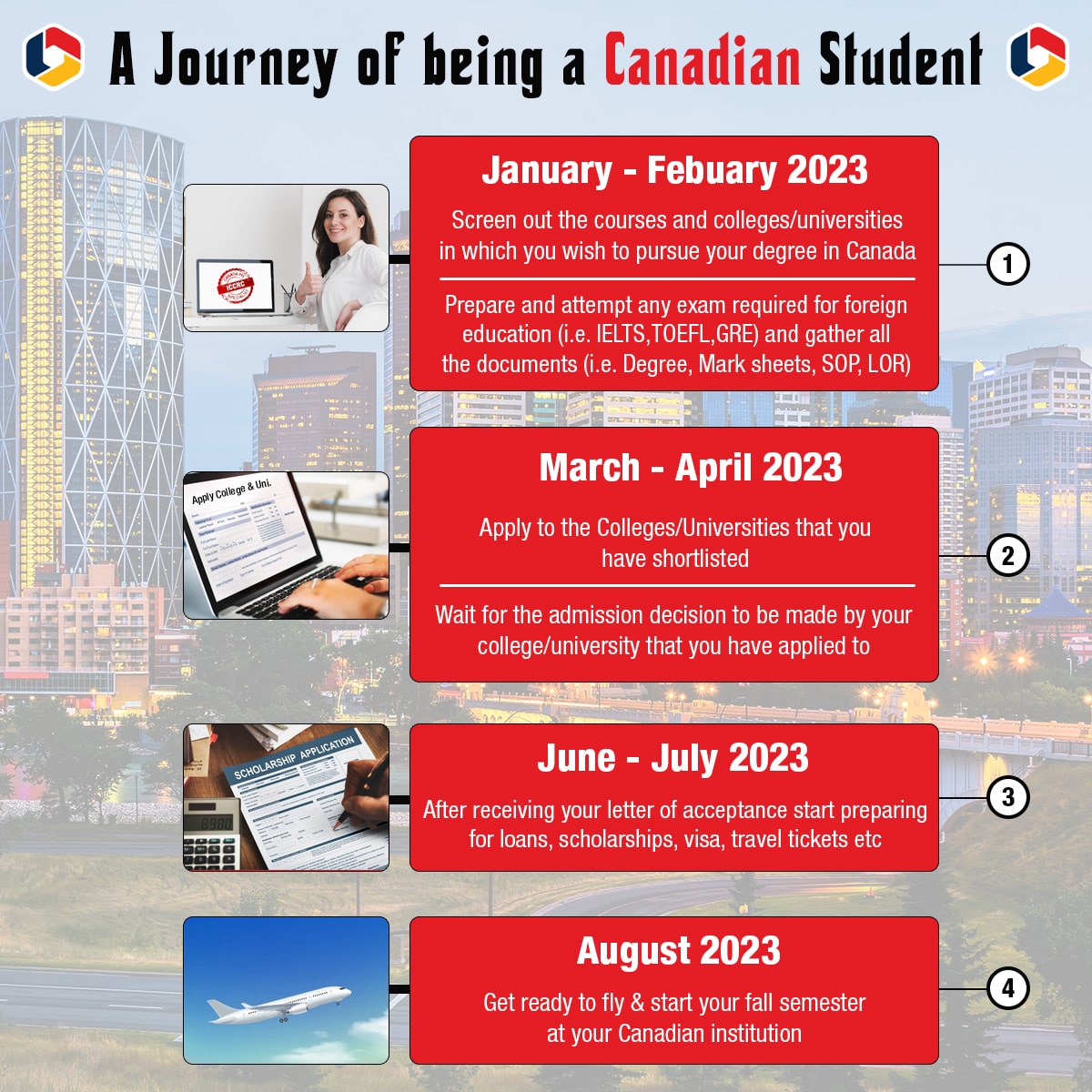
The following flowchart represents the approximate timeline for different intakes. This will help you to understand the timeline and you can make your plans accordingly.
Overall Timeline for Fall 2023 Intake
Scholarship and Loans
The majority of the folks fascinates about “Steps to apply for scholarships and educational loans”. Maximum colleges/Universities automatically enroll the international students for the scholarships, when they get admitted into their college/university. In certain colleges/universities, the students don’t get automatically enrolled and sometimes they miss the deadlines to apply for the scholarships. Thereby, it is the duty of an individual to check the timeline and availability of the scholarship. Other than university and college scholarships, there are various other scholarships that are given by the Government of Canada and others.
Below is the list of scholarships available, in which a particular applicant can apply for it. You can visit the individual scholarship’s website for more details.
Sr. No.
Scholarship Title
Eligibility
1
Vanier Graduate Scholarship
Applicants can be tested for their leadership qualities in order to be eligible
2
Ontario Graduate Scholarship (OGS)
This scholarship is available for limited DLI approved institutions who are affiliated with the OGS
3
Canadian Studies Post-Doctoral Fellowship
This scholarship is available for all the PhD holders who has completed their thesis in last 5 years and are currently not employed
4
IDRC Research Award
Applicants from specified countries who are pursuing their masters or PhD in the DLI approved institutions are eligible
5
Banting Post-Doctoral Scholarship
Students must be enrolled in one of the following graduate programs at approved DLI institutions: Social Science, Health Studies, Environmental Science
6
Partnership Grants by Social Science & Humanities Research Council in Canada
Applicants who are pursuing their PhD programs in specific courses of humanities at one of qualifying universities of Canada are eligible
7
Canada ASEAN SEED Scholarship
Applicants who are qualified as certified professionals from countries like Malaysia Myanmar, Cambodia, Vietnam, Indonesia, Brunei, Laos, Philippines, Thailand & Singapore are eligible
8
Ontario Trillium Scholarship
Applicants who are studying their PhD in the DLI approved institutions in Ontario province are eligible
9
Quebec Provincial Government Scholarship
Applicants who are studying their masters & PhD in the DLI approved institutions in Quebec are eligible
10
Trudeau Scholarship & Fellowship
Students who are pursuing their doctoral degree in Canada are eligible
11
Anne Valle Ecological Fund
Students who are studying PhD in Animal Science at University of British Columbia/University of Quebec are eligible
12
Canada Memorial Scholarship
Available to the students from UK who wishes to pursue their post-graduate studies from Canada
Student loans are available in many private organizations/banks or government banks. Different banks/organization has different interest rates and moratorium period according to their policies. The following documents are needed while applying for the student loan:
The hype of folks travelling to Canada has been continually increasing in the last few years. However, it is easy for the students to get their documents ready for the study permit, but the applications might get procrastinated to get approved due to the pandemic.
Canada offers two types of study permit visas:
1) SDS Category: The post covid scenario has changed the processing time for this category significantly. Usually, it takes 20-25 days to get the visa approved in this category, but nowadays it takes 4-6 weeks to get the study permit approved. The fees for this category are estimated to be 150 CAD. Students need to match the following criteria if they want to file their visa under this category:
A valid Passport
Offer Letter from one of the designated learning institutions (DLI) of Canada
Proof of remittance of your first-year tuition fees
Guaranteed Investment Certificate (GIC)
IELTS Score: 6 bands overall for UG and 6.5 overall for PG; no less than 6 bands in individual modules
Medical examination results
Statement of Purpose (SOP)
2) Non-SDS Category: The time taken to get a study permit approved under this category is approximately around 11-13 weeks. The fees for this category are estimated to be 150 CAD. Students need to match the following criteria if they want to file their visa under this category:
A Valid Passport
Offer Letter from one of the designated learning institutions (DLI) of Canada
Payment proof of the deposit fees remitted to your college/university
Proof of funds: Income tax returns/Bank Statements/Fixed Deposit/Student Loan/GIC/Overdrafts
IELTS Score: 6 bands overall for both UG & PG, not less than 5.5 in individual modules
Medical examination results
Statement of Purpose
Why choose Rao Consultants?
We have been delivering exceptional services for Canada PR, Visas, Foreign Going Coaching Exams, Forex, Air tickets, and many more for the last 20 years. Not only our success rate is high but also we have the belief of 2 lacs families who trust us for their secured future. Over the years, our company has been diligently working with absolute dedication and hard work.
Note: For Canada PR, only ICCRC authorized agents have the authority to file your Canada PR. Being a registered ICCRC member, we have the best success rate that no other has.
Are you having thoughts about settling in Canada via a work visa?
Here’s what you need to know!
Canada is one of the most desirable destinations globally for all the working professionals who are thinking about settling with their family. Here you will get a perfect balance between life and work. The prime advantages for working in Canada are high career opportunities, pathway to Canada PR, affordable cost of living, workplace insurance coverage, Paternal/Maternity leave benefits etc.
What are the documents required for a work visa?
A valid passport
Recent Passport sized photographs – 2
LMIA Letter
Proof of funds
Medical Examination proof from registered hospitals
Educational and work experience
Application fee receipt
What is an LMIA Letter?
An employee in Canada needs a Labour Market Impact Assessment (LMIA) certificate in order to hire an overseas immigrant worker.
LMIA represents the need of employing an immigrant worker to fill the job vacancy. It also represents that no Canadian resident or permanent resident is at hand to do the job. A positive LMIA is sometimes also known as a confirmation letter.
Not every type of work permit requires a LMIA to be issued. There are some job streams that come under LMIA exemptions and the International Mobility Program is designed by the Government of Canada for those jobs. If someone is hiring foreign workers through this program then they need to pay an employer compliance fee, which will generate a unique number in the employer portal, and that number can be used by the worker while filing a visa.
After getting an LMIA letter from the employer, the validity of the LMIA letter is up to 6 months for foreign workers, which means that the foreign worker has to file the visa under this period.
Types of Streams under LMIA
There are mainly 8 types of streams that come under LMIA. The following are the streams:
LMIA required for low-wage stream: This category is specifically designed for the foreign immigrant workers who are paid less than a provincial or territorial median hourly wage.
LMIA required for high-wage stream: This category is specifically designed for the foreign immigrant workers who are paid more than a provincial or territorial median hourly wage.
Below is the table which shows the median hourly wages for individual province and territory:
Province/ Territory
Median Hourly Wage (CAD$)
Alberta
27.28
British Columbia
25.00
Manitoba
21.60
New Brunswick
20.12
Newfoundland and Labrador
23.00
Northwest Territories
34.36
Nova Scotia
20.00
Nunavut
32.00
Ontario
24.04
Prince Edward Island
20.00
Quebec
23.08
Saskatchewan
24.55
Yukon
30.00
LMIA required for agricultural workers: Under this stream, the employer can hire foreign workers only for on-farm primary agricultural activity.
LMIA required for seasonal agricultural workers: Under this stream, the employer mainly hires citizens of approved countries to perform on-farm primary agricultural activity.
However, the key difference between this two streams is, seasonal agricultural worker program hire only foreign workers of some specified countries like: Mexico and Caribbean countries of Anguilla, Antigua and Barbuda, Barbados, Dominica, Grenada, Jamaica, Montserrat, St. Kitts Nevis, St. Lucia, St. Vincent and the Grenadines and Trinidad and Tobago, while agricultural worker stream hire foreign workers all over the world. Moreover, the seasonal agricultural worker program has a maximum employment period of 8 months, while the agricultural worker program has a maximum employment period of 2 years.
LMIA required for a Permanent Residency (PR) application: This stream is specifically designed for high salary jobs which come under skill type and level A and B in National Occupational Classification.
Dual Intent LMIA: This stream has mainly two purposes, one is to support PR and second is to assess work permit application at same time. If a positive LMIA is granted, then the worker will get an additional score of 200 CRS Points in the express entry system for an offer in NOC 00 job, and a score of 50 CRS Points in the express entry system is rewarded for an offer in NOC 0, A or B job. This will augment the worker’s chances to get Canada PR.
LMIA required for Global Talent Stream: The Global Talent Stream (GTS) Canada permits the Canadian employers to accelerate the hiring of foreign immigrants to fill specialised roles or positionswhere Canadian citizens could not fill the specific occupations. The in-demand highly skilled positions are listed on the global talent occupation list. There are two categories under global talent stream:
Category A: This category allows inventive firms in Canada to hire specialized foreign workers. It is subjected to a condition that the company must be a Canadian based firm, innovation-oriented, have an objective to grow and step up and also lookout to fill a unique and specialized position.
Category B: Employers in Canada can employ in-demand highly skilled positions that are listed on the global talent occupation list. Minimum wage requirements must be met too.
LMIA required for in-home caretakers: Canadians can employ foreign caretakers to take care of people of all the age with certified medical needs in private households. Caretakers must be full time employed (i.e. minimum 30 hours per week). Categories of professions eligible for home child care provider pilot and home support worker pilot are as follows:
Home child care provider (NOC 4411)
Home support worker (NOC 4412)
The processing time and fees for different streams under LMIA
The following table lists the information about various streams having different processing time and fee:
Stream
Processing Time (Business Days)
Fee (CAD$)
Global Talent Stream
9
1000
Agricultural Worker Program
16
1000
Seasonal Agricultural Worker Program
8
1000
Permanent Residence Stream
16
1000
In-Home Caregivers
15
1000
High-Wage Stream
34
1000
Low-Wage Stream
31
1000
Conclusion:
Finding a job in Canada and getting a genuine LMIA is required to file the work permit visa to Canada, and it might be difficult to find an authorized employer for the job.
Note: Beware! Most of the Consultants who are promoting to offer LMIA Letter have no direct link/authority to file work permits for Canada, therefore it is highly advisable to check the authenticity of the LMIA and other documents before applying for work permit visa.
It’s easy to directly get the Canada PR rather than filing for work permit, and Rao Consultants has been known as one of the best immigration consultants for filing Canada PR across western India. We have more than 20 years of experience, and a trust of 2 lakh families. As accredited members of ICCRC, we ensure our clients the highest standards of Canada visa services. The absolute dedication, diligence, and attention have driven us to the top of the list of anyone hoping to settle abroad. Get your Canada PR eligibility checked by the experts.
As per the Government of Canada, authorized consultants who are ICCRC members can only process your PR file. Ask your consultants ICCRC authorization before initiating your PR process.
Express Entry system is one of the immigration programs developed by the Immigration, Refugees and Citizenship Canada (IRCC), which is basically a point based system on which you get assessed for the Canada PR.
Express entry program are for those skilled workers who wants to immigrate to Canada as Permanent Residents. Getting invitations from the Canadian government is not a cake walk. That’s why we assist you in getting your PR in the least time as possible, also getting your PR chances becomes high when you file for PR from Rao Consultants.
There are three programs under this immigration system:
1) The Federal Skilled Trades Program
This program is designed for those skilled workers who have at least 2 years of full time experience in the following skills trade:
Industrial and construction trade
Maintenance and equipment trade
Inspectors and technicians in natural resources, agriculture and related production
Processing, manufacturing and utilities inspectors and control operators
Chefs, cooks, butchers and bakers
2) The Federal Skilled workers Program
This program is designed for those skilled workers who have at least 1 years of full time, or equal amount of part time work. Candidates are assessed on the basis of 100 points grid. The current cut-off is 67 points. Applications are assessed on the basis of age, education, work experience, valid job offer, language proficiency, adaptability.
3) The Canadian Experience Class
This program is designated for those skilled workers who have Canadian work experience. Candidate should have at least 1 year of experience either at full time (30 hours per week) or part time (15 hours per week) under NOC 0, A or B jobs.
Eligibility Criteria for Express Entry
Eligibility completely depends on an individual’s profile. The following key points are required to be eligible:
You need to have at least one year of work experience.
Your age must be in the range of 25–45 (Age range between 25–35 gets the maximum points, while your points will be deducted as your age increase from 35 to 45)
You must need either English or French test score as a proof of first language test, and you can also submit either French or English test score as a second language test which can give you additional points benefits.
For PR process you need to contact authorized ICCRC members who can file your PR. Rao consultants are authorized ICCRC members who can file your PR in the least time and have high PR success ratio.
5 Simple Steps to Make Ready Your PR Profile for Express Entry
Check your eligibility
Get your documents ready (IELTS Scorecard, ECA, PCC, MC, Funds)
Apply for the Canada PR
Get your Invitation Letter
Get ready to fly
Note: Express entry draw takes place approximately around every 15 days
Below is the list of the express entry draw issued in the span of 7 years (i.e. 2015-2021)