News

admin
November 18, 2023
“Beyond Borders: SINP Adds 279 New Occupations, Fueling Saskatchewan’s Immigration Ascent to 1.4 Million by 2030”
The Saskatchewan Immigrant Nominee Program (SINP) has announced the addition of 279 new occupations to its Existing Work Permit stream, making it easier for temporary foreign workers in lower- and intermediate-skilled jobs to apply for permanent residency.
The expansion, which took effect on November 10, 2023, is part of the Saskatchewan government’s efforts to address labour market shortages and attract and retain new residents.
Through this development, the government aims to improve employee retention and directly address labour market shortages faced by Saskatchewan employers.
The government is also helping Saskatchewan’s businesses and economy by giving displaced Ukrainians and other foreign workers more opportunities to become permanent residents.
“The expansion to the SINP program is a good first step as it enables us to support our employees in the immigration process while also helping us fill vital positions,” stated Brennen Mills.
Who can apply?
To be eligible for this program, candidates must possess a work permit, including a francophone mobility work permit, a work permit supported by the Labor Market Impact Assessment (LMIA), or a Canadian Ukrainian Authorization for Emergency Travel (CUAET) visa for newly arriving immigrants from Ukraine.
Saskatchewan’s Ambitious Vision: Targeting 1.4 Million Residents in the Next Six Years.
Saskatchewan, a province known for its expansive landscapes and vibrant communities, is embarking on an ambitious journey to increase its population significantly. The target: welcome 1.4 million residents within the next six years. This bold vision, articulated by provincial Immigration Minister Jeremy Harrison, signifies more than just a numerical milestone – it represents a strategic and forward-thinking approach to fuel the province’s economic engine.
Economic Confidence and Prospects:
The decision to pursue such a substantial population increase is grounded in a robust belief in Saskatchewan’s economic vitality. The province has been experiencing record-high population growth rates, indicating a positive trajectory regarding economic opportunities, employment prospects, and overall quality of life. By setting the ambitious goal of 1.4 million residents, Saskatchewan is signalling its confidence in sustaining and accelerating this growth.
Role of Immigration in Growth Strategy:
Immigration stands at the forefront of Saskatchewan’s growth strategy. Minister Jeremy Harrison’s vision recognises newcomers’ pivotal role in contributing to the provincial economy, fostering innovation, and enriching the cultural fabric of communities. Saskatchewan has historically embraced immigrants, viewing them as contributors to the labour market and essential to the province’s long-term success.
Government Initiatives and Collaboration:
To transform this vision into reality, Saskatchewan is actively working with Immigration, Refugees and Citizenship Canada (IRCC) to streamline immigration processes. The aim is to grant the province greater autonomy in determining the eligibility of applicants, enabling a more responsive and flexible approach to immigration that aligns with the specific needs of Saskatchewan’s labour market.
Population Growth as Economic Driver:
Saskatchewan’s pursuit of 1.4 million residents is not solely about demographics; it’s a strategic move to address labour market demands, fill critical job vacancies, and create a thriving and diverse community. The province anticipates a productivity, innovation, and economic resilience boost by attracting and retaining skilled professionals.
Whether building a career, reuniting with family, or contributing to the province’s growth, our proven expertise ensures a smooth journey. Embark confidently – visit us and explore your Saskatchewan opportunities today.”
You May Also Like
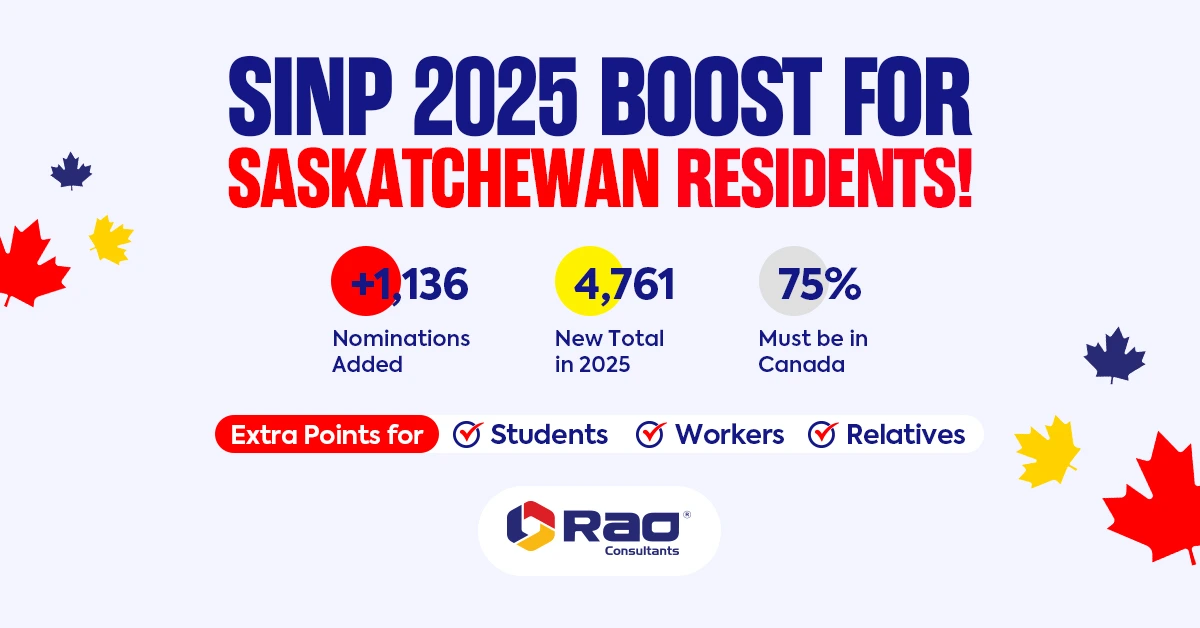
SINP 2025 Update: Saskatchewan Gets 1,136 Extra Nominations – Total Now 4,761
Saskatchewan has received 1,136 additional provincial nomination spaces for 2025 under the Saskatchewan Immigrant Nominee Program (SINP), taking the province’s total allocation to 4,761 for the year. The boost follows earlier reductions to provincial allocations and is aimed at easing labour shortages in key sectors. What changed – and why it matters More nomination spaces […]
Read More
Canada to Accept TOEFL Essentials Test for Permanent Residency Applicants
Toronto, August 2025 – In a move to broaden language testing options, Immigration, Refugees and Citizenship Canada (IRCC) has confirmed that it will soon accept the TOEFL Essentials test, administered by the Educational Testing Service (ETS), as an official proof of English proficiency for permanent residency (PR) applications New Accessible Pathway for Applicants The inclusion […]
Read More
Government Raises Income Thresholds for Hosting Parents and Grandparents in Canada
As of July 29, 2025, Canadian hosts wishing to bring their parents or grandparents under the Super Visa program must meet higher minimum income thresholds, reflecting a 3.9% increase over 2024 levels. 💰 New Income Requirements by Family Size (Canadian Dollars) Family Size Minimum Income Needed in 2025 Minimum Income in 2024 1 (sponsor alone) […]
Read More